
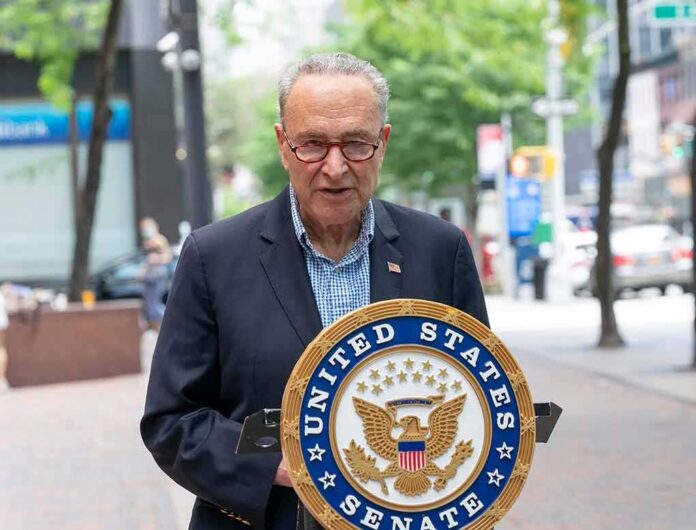
Senate Democratic Leader Chuck Schumer is openly mapping out a long-term campaign to use Congress, the courts, and media pressure to “hold Donald Trump accountable” and box in his agenda.
Story Snapshot
- Schumer vows Democrats will “hold Donald Trump’s feet to the fire” and treat accountability as their main mission.
- Senate Democrats are organizing oversight, lawsuits, and messaging to frame Trump’s policies as corrupt or anti-democratic.
- Their push leans on allegations and press reports, not on new court rulings proving Trump corruption.
- The strategy risks turning Congress into a permanent campaign weapon instead of a lawmaking body.
Schumer’s Promise To Target Trump From The Senate
New York Senator Chuck Schumer has been clear for years that Democrats see “holding Donald Trump accountable” as a central mission in Congress. In one radio interview, Schumer said their job at the start was to “hold Donald Trump and the Republican majority accountable,” vowing to keep constant pressure on the White House. That language matters today because it shows this is not a neutral oversight push. It is a declared political strategy to keep Trump under investigation and on defense.
Schumer’s framing fits with a broader pattern of Democrats and left-leaning scholars painting Trump as uniquely corrupt and dangerous. Harvard Law analysis, for example, claimed that Trump and his family “flagrantly” ignored norms that separate public power from private gain. Many opinion writers now argue Trump’s record “surpasses” past administrations in misconduct. These claims, often repeated by Senate Democrats, set the tone for their pledge to hold Trump “to the fire,” even though they are largely based on ethics reports and opinion pieces, not fresh legal verdicts.
A Multi-Front Plan: Oversight, Lawsuits, And Media Pressure
In a strategy letter to Senate Democrats, Schumer laid out four fronts for pushing back on Trump: oversight, litigation, legislation, and aggressive communications. On oversight, he urged committees to probe the “intent, legal justification and real-world impact” of Trump’s actions and to work closely with whistleblowers, including a new portal for tips about alleged abuses of power. On litigation, he cast the courts as the “first line of defense” against Trump policies, signaling support for lawsuits that try to block executive decisions.
Schumer also described a legislative tactic built around using Democrat votes as leverage, even from the minority, to “steady the ship” during what he called turbulent times. He pointed to fights over spending bills and shutdown threats as moments when Democrats could force concessions on policy. Finally, he highlighted a “coordinated, aggressive” communications effort led by fellow Democrats to keep the caucus “informed, united, and amplifying the truth behind the Trump Administration’s agenda.” That last piece shows how much this plan focuses on shaping public opinion, not just writing law.
From Corruption Claims To Election And Democracy Fights
As Trump returned to the White House, Schumer and key allies shifted from Russia and Ukraine-era battles to new accusations about corruption, democracy, and national security. Senate Democrats rolled out reports claiming Trump turned the presidency into “eye-popping profits” for himself and his family, and floated numbers in the billions tied to business and crypto earnings. They announced probes into alleged “pay-to-play corruption” around a privately funded White House ballroom, suggesting wealthy donors were buying access and influence.
Schumer has also used the Senate floor to accuse Trump of dragging the country “closer to autocracy” by demanding that all legislation be blocked until his preferred election bill, the SAVE Act, is passed. In another speech, he charged that Trump was “weaponizing” the Department of Justice to go after political enemies and even trying to indict members of Congress for protected speech. These are explosive allegations. But they are coming from partisan actors, not from judges. So far, the record presented by Democrats is heavy on press releases, investigations, and media commentary, light on final court rulings that prove the broad charges.
What This Means For Constitutional Conservatives
For constitutional conservatives, Schumer’s plan raises serious questions about separation of powers and political abuse of oversight. When the Senate’s minority or majority leader openly treats “holding Trump accountable” as a top goal, oversight risks turning into a permanent campaign instead of a tool to protect taxpayers. Using subpoenas, Freedom of Information Act requests, and ethics reports as weapons can chill lawful policy moves on border security, energy dominance, and deregulation that many voters backed Trump to deliver.
Trump himself has blasted many of these investigations as “nonsense” and “games,” saying they were simply the start of the next campaign season. His pushback, while political, underscores a key gap in the Democrats’ case: they have produced many allegations and colorful reports, but they have not yet delivered the kind of clear, final judicial finding that would justify branding the entire agenda as corrupt. Until that happens, Schumer’s vow to “follow the money” and keep Trump under a microscope looks less like neutral law enforcement and more like a long-term effort to weaken a populist presidency that threatens the old Washington order.
Sources:
youtube.com, democrats.senate.gov, reuters.com, epw.senate.gov, whitehouse.senate.gov, abcnews.go.com, bloomberg.com, brookings.edu, americanheritage.com