
China barred an American journalist from the Trump–Xi–Putin summit after she asked a tough question, even after a White House push to let her in.
Story Highlights
- Chinese officials blocked Bloomberg’s Annmarie Hordern from the trilateral session after an earlier shouted question.
- White House representatives asked China to restore her access; Chinese authorities refused.
- Press pool messages said shouting questions would be treated as “extremely rude,” with removal as a consequence.
- The incident spotlights China’s tight control over foreign press access at high-level events.
China Blocks U.S. Reporter After Earlier Question
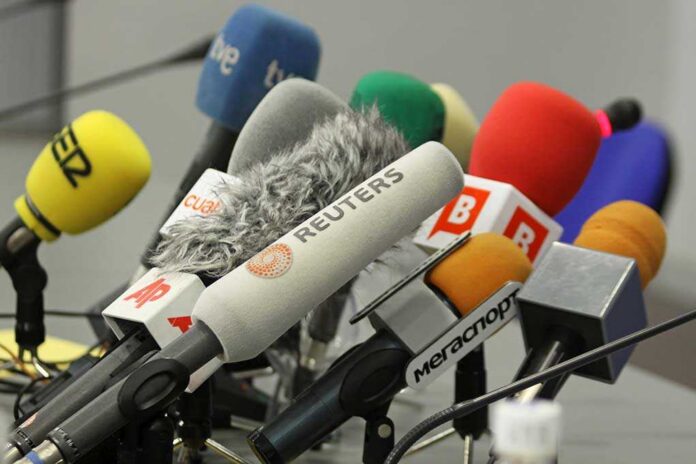
Chinese authorities prevented Bloomberg correspondent Annmarie Hordern from entering the opening remarks of the Trump–Xi–Putin trilateral meeting. The move came shortly after she shouted a question during an earlier Trump–Xi photo spray. She asked, “President Trump, has Jensen Huang been disloyal to the United States?” Reports describe the exclusion as linked to that earlier question and conduct. The White House press pool circulated the sequence and reason given by Chinese officials to the traveling media.
White House representatives sought to reverse the ban and pressed Chinese officials to admit Hordern to the room. Chinese authorities did not yield. TheWrap reported that a White House official said they attempted to reinstate her but were rejected. The decision kept a credentialed American reporter out of a newsworthy moment featuring the leaders of the United States, China, and Russia, despite direct advocacy by U.S. officials on site.
Press Pool Guidance And China’s Rationale
Traveling pool messages relayed a warning from Chinese officials about behavior in the room. Reporters were told that yelling questions was “extremely rude” and could lead to removal. That message was shared with the broader press pool, not just Hordern. The reported standard centered on decorum during staged sprays. It set a conduct line that Chinese hosts said they would enforce at the venue during leader appearances and opening remarks.
U.S. press norms also value order during brief remarks, but they balance that with access. The White House Correspondents’ Association guidance says shouting over colleagues is unacceptable. It also stresses the importance of open press as the default in coverage principles. The norms show two aims that can collide: keep order in tight spaces and avoid using access as punishment for journalism that is inconvenient or off-script.
What Happened Inside The Room And Why It Matters
Pool reports say the ban applied to the opening remarks of the trilateral session. Other credentialed reporters were allowed to enter and observe the spray, while Hordern was stopped. The Boston Globe and Fox News both tied the denial directly to the earlier shouted question and cited the specific warning on conduct that Chinese officials gave to the pool. The resulting dispute became part of the summit’s news, alongside policy topics on the table that day.
The incident highlights China’s tight media controls when it hosts major events. U.S. outlets reported limited visibility and strict rules for foreign press around the summit. The Hill noted that Chinese restrictions on access shaped coverage of key moments. This environment puts added pressure on American officials to defend access, even when hosts insist on strict decorum rules during short, choreographed leader appearances.
Conservative Takeaways On Free Press And Sovereignty
American readers expect that reporters can ask leaders hard questions. That is part of our free press tradition. Chinese officials framed this as a decorum issue. The outcome still meant a foreign government decided which American reporter could observe a moment with our president. The White House tried to fix it and was rebuffed. That clash shows how authoritarian systems use etiquette to control what the public sees and hears at high-stakes meetings.
The content of the question also mattered to the moment. It touched on national loyalty and technology ties. Sensitive topics often face tighter control in China’s media environment. Regardless of one’s view of the question, the response sends a clear message: access can hinge on pleasing the host, not on serving the public. That is the opposite of how American press freedoms work, and it is why firm U.S. advocacy for open access remains essential.
Sources:
thenightly.com.au, bostonglobe.com, wrbl.com, whca.press