
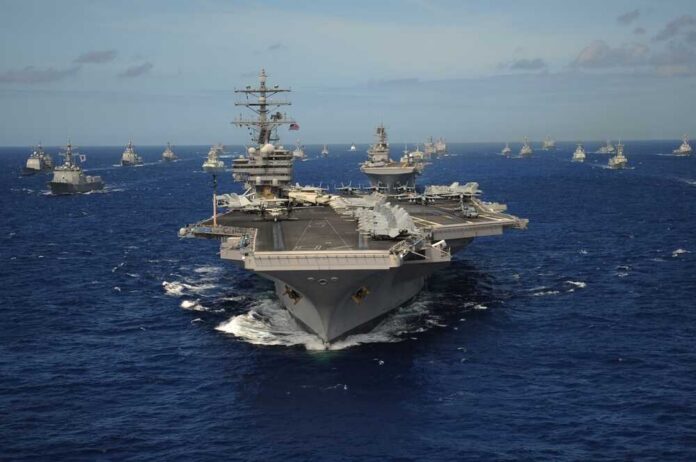
President Trump’s naval blockade of Iran, launched with over 15 warships and 10,000 troops, marks an unprecedented escalation in what both sides now openly call economic warfare over control of the world’s most critical oil chokepoint.
Story Snapshot
- US imposed full naval blockade on Iranian ports April 13, 2026, after peace talks collapsed and Iran restricted Strait of Hormuz shipping
- Vice President JD Vance labeled Iran’s strait closure “economic terrorism,” prompting Trump’s counter-blockade with massive military deployment
- Oil prices surged near $100 per barrel as shipping through the strait—handling 20% of global oil—plummeted from 19 vessels to just 4
- Iran pivoted to land-based trade routes through Pakistan and Turkey, launching new rail corridors to bypass the maritime stranglehold
- China condemned the US action as “dangerous and irresponsible,” highlighting growing tensions over energy security amid the wartime standoff
Mutual Blockades Transform Regional Conflict
The Trump administration’s April 13 blockade represents a direct response to Iran’s closure of the Strait of Hormuz following US-Israel strikes on February 28, 2026. CENTCOM forces now patrol Iranian ports and the southern coastline with orders to interdict vessels entering or departing Iran, threatening even neutral ships paying Iranian transit tolls. This tit-for-tat escalation differs sharply from previous Hormuz tensions, establishing mutual maritime sieges unprecedented in modern naval conflict. The failed ceasefire of April 7 and collapsed Islamabad peace talks on April 12 set the stage for this confrontation, effectively weaponizing the 21-mile-wide chokepoint that’s been a flashpoint since the 1980s Iran-Iraq Tanker War.
Economic Warfare Ripples Across Global Markets
Shipping data reveals the blockade’s immediate impact: vessel transits dropped precipitously after the April 13 deadline, with only four US-sanctioned or Iran-linked ships recorded on April 14 compared to 19 the previous Sunday. Oil markets responded with prices climbing toward $100 per barrel, threatening what some analysts call an “Iran war tax” on global consumers. Marine Traffic tracking shows civilian shipping firms are cutting signals and avoiding the region entirely, deterred not just by the US blockade but by Iranian attack risks predating the naval deployment. This disruption affects Asia most severely, particularly China—Iran’s top oil buyer—which condemned the blockade as exacerbating regional tensions while facing potential energy shortages.
Iran Shifts Strategy to Land-Based Corridors
Tehran’s Interior Minister Escandar Mini has mobilized Iran’s 8,000 kilometers of land borders as an “economic shield” against maritime pressure. Provincial governors are expanding rail and road trade with Pakistan, Iraq, and Turkey, with the first shipment from Pakistan’s Gwadar port to Tashkent already completed. This geographic pivot exploits Iran’s continental position, using newly developed corridors to sustain commerce while naval routes remain blocked. Iranian officials frame these land routes as a “quiet answer” to US pressure, demonstrating how the regime is adapting to circumvent naval superiority. The strategy underscores a fundamental reality: while the US controls the seas with overwhelming force, Iran leverages alliances with Pakistan and China to maintain economic lifelines beyond Washington’s reach.
Escalation Risks and Fragile Deterrence
The blockade’s effectiveness remains uncertain as contradictions emerge in reported data. President Trump claimed 34 vessels transited on Sunday, while tracking sources documented only 19, suggesting possible inclusion of unverified ships or discrepancies in monitoring. The US military’s authority to block neutral vessels if Iranian-linked raises enforcement questions, particularly as ships reportedly cut identification signals to evade detection. Expert analysis from the American Enterprise Institute characterizes the blockade as “temporary” leverage to stop Iran from “extorting the global economy,” yet the April 7 ceasefire’s fragility and absence of diplomatic progress suggest prolonged confrontation. This stalemate carries broader risks: potential collapse into wider Gulf conflict if Iran retaliates against regional ports, zero Iranian oil exports if the blockade persists, and insurance costs skyrocketing across already-disrupted shipping lanes.
The mutual blockades expose a troubling pattern familiar to Americans frustrated with elite decision-making: leaders on both sides prioritizing geopolitical leverage over the economic stability of ordinary citizens worldwide. Families across Asia face rising energy costs, Gulf communities navigate maritime dangers, and Iranian civilians depend on hastily arranged land routes for essential goods—all while diplomats failed in Islamabad and military forces escalate. Whether this economic warfare achieves strategic objectives or merely prolongs suffering depends on decisions made far from those bearing the consequences, a dynamic that transcends partisan divisions and fuels cynicism about government priorities on both the American left and right.
Sources:
US Military Deployment to Persian Gulf