

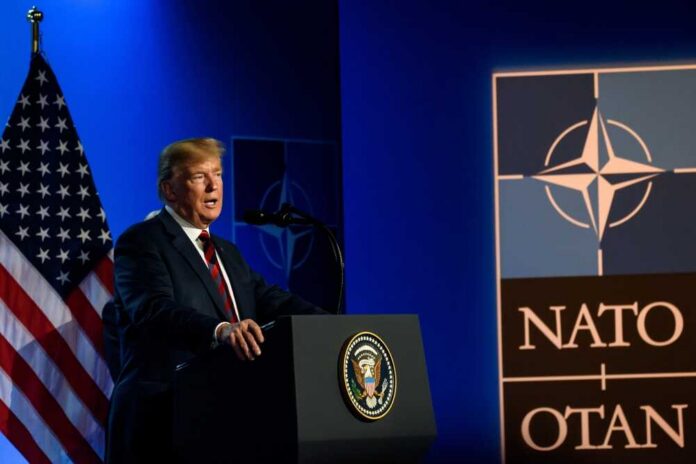
While China now operates the world’s largest navy, the Trump administration is moving to shrink U.S. military commitments to NATO — a calculated gamble that demands Europe finally pull its own weight after decades of freeloading on American defense spending.
Story Snapshot
- Reports indicate the U.S. plans to cut fighter jets available to NATO by one-third, halve strategic bomber commitments, reduce destroyers, and assign zero submarines to NATO crisis scenarios.
- The Pentagon also announced plans to withdraw roughly 5,000 troops from Germany and cancel a brigade rotation to Poland.
- The Trump administration frames the reductions as a burden-sharing push, not an abandonment — the U.S. nuclear umbrella for NATO members remains in place.
- European allies face a stark choice: dramatically increase their own defense spending and capabilities or accept a widening security gap at a moment of rising global threats.
What the Reported Cuts Actually Look Like
German news outlet Der Spiegel first reported the scope of the proposed reductions, and the details are significant. Fighter jets available to NATO would drop by roughly one-third, strategic bombers by half, and naval destroyers would be reduced. Most striking, zero U.S. submarines would be allocated for NATO crisis use under the reported plan. [1] These are not symbolic trims — submarines, strategic bombers, and destroyers represent the backbone of high-end deterrence and crisis response in the Atlantic theater. [4]
Alongside the asset reductions, the Pentagon announced plans to withdraw approximately 5,000 troops from Germany and cancel a scheduled brigade rotation to Poland. [2] Together, these moves represent one of the most concrete force-posture shifts in U.S.-NATO relations in years, and they arrive at a moment when Russia’s aggression in Ukraine has already put European security under a microscope. The underlying Pentagon directive has not been publicly released, so the exact scope and conditions remain based on secondary reporting rather than official documentation. [1]
Trump’s Leverage Play: Europe Must Carry More Weight
The administration is framing these reductions not as retreat but as a long-overdue correction to an imbalanced alliance. For decades, European nations have sheltered under American military power while chronically underfunding their own defense budgets. The United States historically funded roughly 22 percent of NATO’s common-funded budgets and carried a 40 percent cost share in shared assets like the NATO Airborne Warning and Control System force. [3] That arrangement made sense during the Cold War. In 2026, it’s harder to justify.
Trump’s push for European burden-sharing is not a new idea — it’s a demand that previous administrations raised and then quietly dropped when allies pushed back. The difference now is that Washington appears willing to follow through with concrete capability reductions rather than just rhetoric. Reporting describes the cuts as “one of the most concrete steps yet” in shifting defense responsibilities to European allies, while the U.S. nuclear umbrella reportedly remains intact. [1] Whether European nations can actually replace withdrawn U.S. fighters, submarines, and bombers in any reasonable timeframe is an open and serious question. [2]
The China Problem Nobody Is Talking About Loudly Enough
The strategic backdrop to all of this is a U.S. military that faces mounting demands across multiple theaters simultaneously. China now operates the largest navy on earth by vessel count, and it continues an aggressive shipbuilding program aimed at projecting power across the Indo-Pacific and beyond. Every destroyer, submarine, and bomber committed to NATO’s European crisis pool is an asset that cannot be repositioned quickly toward the Pacific if tensions with China escalate. Force planners in Washington have to make hard choices about where American power is most urgently needed.
Critics who frame these NATO reductions purely as abandonment miss the broader strategic logic. The United States cannot indefinitely maintain Cold War-era European force commitments while simultaneously building the naval and air power necessary to deter China in the Pacific. Europe has wealthy economies, advanced defense industries, and decades of NATO interoperability experience. Germany, France, Poland, and the United Kingdom have the capacity to fill capability gaps if they choose to prioritize defense spending. The question is whether the reported U.S. reductions will finally force that political will into action — or whether Europe will simply demand Washington reverse course without making meaningful investments of its own. [2] Either way, the era of America subsidizing European security while facing a peer competitor in Asia is drawing to a close.
Sources:
[1] Web – Report: U.S. To Cut Strategic Bombers and Warships Available to NATO
[2] Web – US to Cut Military Assets for NATO, Spiegel Reports | KuCoin
[3] YouTube – Pentagon Announces US Will Cut Thousands Of Troops In Europe
[4] Web – FACT SHEET: U.S. Contributions to NATO Capabilities