
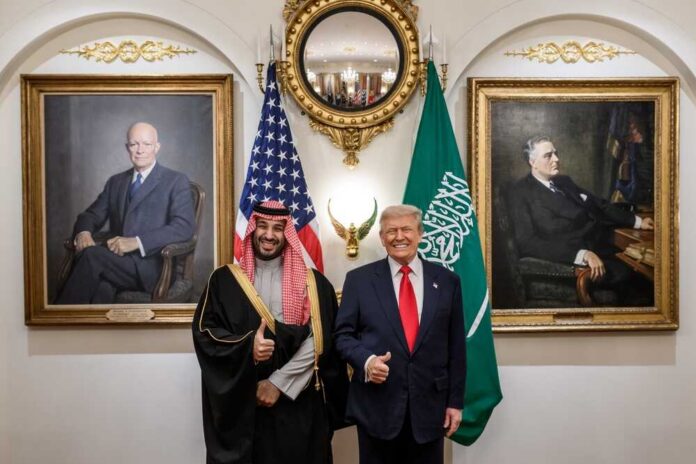
A new wave of reports claiming Saudi Crown Prince Mohammed bin Salman “pushed” President Trump into war with Iran exposes how anonymous leaks and foreign spin are still being used to undermine America’s independent, America‑first foreign policy.
Story Snapshot
- Anonymous reports say Mohammed bin Salman urged Trump to keep U.S. military pressure on Iran and saw a “historic opportunity” in the conflict.[1][2][6]
- Saudi officials publicly denied pressing for escalation and claimed Riyadh was backing diplomacy and restraint.[1][4]
- Later reporting shows Mohammed bin Salman also blocked or limited U.S. operational access, drawing red lines on how far Washington could go.[4]
- The dispute highlights how foreign partners, media leaks, and advocacy outlets can try to shape or discredit Trump’s Middle East strategy.[1][2][3]
Anonymous Claims Say MBS Pushed Trump to “Finish” Iran
Reports from outlets summarizing wire-service style coverage claim that, during a period of intense confrontation with Iran, Saudi Crown Prince Mohammed bin Salman privately urged then‑President Donald Trump to “press on” with military operations.[1][2][6] People described as being briefed by American officials told journalists the crown prince called the U.S.–Israeli campaign a “historic opportunity” to reshape the Middle East by dismantling Iran’s hard‑line regime, language that plays directly into long‑standing Saudi fears of Tehran’s regional ambitions.[1][2]
Some of the same reporting and commentary assert that Mohammed bin Salman went beyond rhetoric and allegedly encouraged Trump to hit Iran’s economic lifeline, including energy infrastructure and key oil facilities.[1][2][3] One account circulated in media coverage said the crown prince even raised the idea of using American ground forces to seize Iranian oil terminals such as Kharg Island, though that dramatic allegation rests entirely on unnamed sources and has not been backed by any official transcript or on‑the‑record documentation.[2][3] These stories quickly moved through secondary outlets and video commentary channels, amplifying the narrative that Riyadh was egging Washington on.
Saudi Public Line: De‑Escalation, Denials, and Red Lines on U.S. Use of Bases
Saudi officials responded to this narrative by issuing categorical denials, rejecting what they called a distorted picture of Riyadh privately pushing Washington toward wider war with Iran.[1] The kingdom’s representatives insisted that its position had “remained unchanged,” emphasizing repeated calls for restraint, de‑escalation, and a diplomatic solution to the crisis rather than an open‑ended campaign of strikes.[4] In their public messaging, Saudi leaders sought to project an image of responsible stewardship in a volatile region, mindful that a full‑scale conflict could put their own territory and energy infrastructure in the crosshairs.
Video analyses and follow‑up coverage also underline that Mohammed bin Salman appears to have drawn clear operational red lines for the United States when it came to any potential attack on Iran.[4] According to those accounts, the crown prince refused American requests to use Saudi airspace and military bases as a launchpad for a major Iran operation, a concrete step that does not fit neatly with the idea that he was simply pressing for escalation at any cost.[4] That stance suggests Saudi Arabia was calibrating its risk, opposing Iran’s behavior but not willing to let its territory become the frontline of a wider war driven by decisions in Washington or Jerusalem.
Why the Evidence Is Murky and How Media Spin Shapes the Story
The clash between anonymous leaks and official denials leaves Americans with a familiar problem: key facts about private leader‑to‑leader calls are classified, while the public debate is driven by “people familiar with the discussions” cited in press stories.[1][2][6] This pattern is common in national‑security coverage, especially in the Middle East, where advocacy media and regional players eagerly frame the same limited set of facts either as pragmatic coordination or as reckless warmongering, depending on their agenda.[1][2] None of the material presented so far includes a primary‑source call transcript that would definitively confirm or disprove the reported lobbying.
For Trump‑era conservatives who favor a strong stance against Iran but reject nation‑building quagmires, the stakes in how this story is framed are high. If foreign capitals or hostile outlets can paint Trump as a pawn of Mohammed bin Salman based on anonymous quotes, they can weaken support for a foreign policy that prioritizes American leverage, energy security, and deterrence without dragging U.S. troops into another endless war.[2][3] At the same time, the mixed record—Saudi talk of “historic opportunity” on one hand, public de‑escalation and blocked base access on the other—underscores why American voters continue to demand that any deployment of force answer to the U.S. Constitution and the American people, not to backchannel requests or anonymous leaks.[1][4]
Sources:
[1] Web – Saudi crown prince urges Trump to press Iran war, warns against …
[2] Web – Is Saudi Arabia calling the shots? Crown Prince MBS urging Trump …
[3] Web – ‘Cut the Head of Snake’ Saudi Prince Urges Trump FINISH Iran
[4] YouTube – Saudi Prince BREAKS RANKS With Trump Over Iran War …
[6] Web – Saudi Arabia’s MBS Urged Trump To Press On With War Against Iran