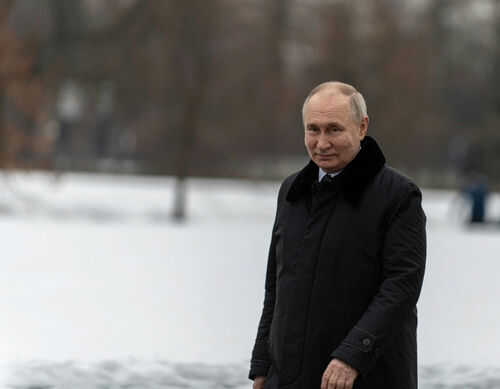
Vladimir Putin just turned America’s Middle East conflict into a multibillion-dollar payday without deploying a single Russian soldier, and most Americans have no idea it happened.
Story Snapshot
- Russia gains $150 million daily from oil revenue spikes during US-Israel-Iran conflict
- Putin positions himself as diplomatic mediator while Western sanctions against Russia quietly pause
- Europe reverses course, pumping $10-15 billion back into Russian gas amid energy crisis
- US spends $18 billion in six weeks while Russia profits from the chaos without military risk
- Iran’s weakening creates reconstruction opportunities for Russian firms and reduces regional competition
The Nonbelligerence Dividend That Changed Everything
The strategic calculus behind Russia’s windfall centers on a simple truth: combatants bleed while bystanders with the right connections collect checks. When US and Israeli forces struck Iranian leadership in late February 2025, oil markets convulsed predictably. Brent crude vaulted past $110 per barrel as the Strait of Hormuz—the chokepoint for 20 percent of global oil—faced blockade threats. Russia’s shadow fleet of tankers, already ferrying sanctioned crude to India and China, suddenly became gold mines on water. Moscow’s Mineral Extraction Tax captured windfall profits at the source, funneling daily revenues exceeding $150 million into state coffers that had been gasping for air under Western sanctions.
OPEC Plus Becomes Putin’s Secret Weapon
Russia’s partnership with Saudi Arabia through OPEC Plus handed Putin a lever few anticipated he would pull so effectively. While American Patriots screamed skyward over the Persian Gulf at a rate exceeding four years of Ukraine aid deliveries combined, Mohammed bin Salman coordinated production cuts that kept prices elevated. The institutional alliance between Moscow and Riyadh, forged in 2016 to stabilize energy markets, now functions as a profit-sharing mechanism during wartime disruption. Unlike China, which lacks formal production coordination power, Russia sits at the table where global oil supply decisions get made. That seat translates into billions when Gulf tensions spike and Western powers need energy stability more than they need sanctions enforcement.
The Diplomacy Game Nobody Saw Coming
European Council President Antonio Costa’s March declaration that Russia is the conflict’s “only genuine beneficiary” acknowledged what diplomats whispered privately: Putin had become indispensable. The Kremlin maintained working relationships with all belligerents—Tehran through drone supply agreements, Riyadh via OPEC Plus, and Washington through backdoor Ukraine negotiations. This triangulation positioned Russia as the sole credible mediator when de-escalation conversations eventually began. Western leaders who spent two years isolating Moscow suddenly needed Putin’s phone lines to Tehran. That diplomatic rehabilitation, worth far more than any sanctions relief dollar figure, reshapes European security architecture for years ahead.
Europe’s Energy Capitulation
The promised forever divorce between Europe and Russian energy lasted until Gulf supply chains fractured. Liquefied natural gas shipments that replaced Russian pipeline flows in 2022 suddenly looked expensive and unreliable with tanker insurance rates spiking and Middle Eastern export terminals in strike zones. Germany and Italy quietly reopened negotiations for Russian gas purchases, reversing three years of energy policy in three weeks. Estimates place the reversal’s value between $10 billion and $15 billion annually—a budget lifeline for a Russian economy that Western sanctions intended to strangle. The geopolitical irony cuts deep: American military action in the Middle East directly funded the adversary America sought to isolate in Eastern Europe.
Iran’s Loss Becomes Russia’s Long-Term Gain
Tehran’s 2025 mutual defense treaty with Moscow, signed amid Ukraine war pressures, proved worthless when Iranian leadership fell to airstrikes. Russia offered no military intervention, calculating that a weakened Iran serves Russian interests better than a strong ally. Post-war reconstruction contracts in Iranian infrastructure and energy sectors now flow to Russian firms facing fewer competitive bidders. Iranian dependence on Russian technology for air defense and drone production deepens without the reciprocal obligations a functioning alliance would demand. Central Asia, long contested between Russian and Iranian influence, tilts further toward Moscow as Tehran’s regional clout collapses under regime instability and protest movements.
The Ukraine Distraction Dividend
Every Patriot missile fired over the Persian Gulf represents one fewer available for Ukrainian air defense. Every billion dollars Congress allocates to Middle East operations is a billion not flowing to Kyiv. NATO attention, fractured between two theaters, benefits the actor fighting in only one. Russian forces capitalized on reduced Western focus to consolidate territorial gains in eastern Ukraine while American politicians debated Middle East appropriations. The strategic bandwidth problem facing Washington—managing peer competitors on multiple fronts with finite resources—plays directly into Putin’s multi-year war of attrition calculus. Turkish President Erdogan recognized this dynamic, positioning his country as a neutral winner by denying US airspace access while criticizing both American strikes and Iranian retaliation.
The Shadow Fleet That Sanctions Forgot
Thirty-plus Russian tankers tracked by Western intelligence agencies move sanctioned crude with near impunity as enforcement priorities shift to Middle East stability. The same shadow fleet that linked Russian, Iranian, and Venezuelan oil flows suddenly became too economically important to fully disrupt. Crackdowns that might have crippled Russian exports in peacetime now risk exacerbating global supply crunches during active conflict. This operational breathing room extends Moscow’s sanction evasion infrastructure for years, embedding alternative payment systems and shipping networks that will outlast the current crisis. The Biden administration’s Venezuela blockade efforts, intended to squeeze the Russia-Iran-Venezuela axis, buckled under energy price pressures that voters feel at gas pumps.
The proxy war model Russia perfected in Syria and exported to Ukraine found its most profitable application yet in a conflict where Russian interests advanced without Russian casualties. Seven distinct dividends—oil revenue surges, sanctions pauses, diplomatic centrality, drone technology refinement, European energy dependence restoration, Iranian competitor weakening, and Ukraine distraction—compound into a strategic jackpot that validates Putin’s long-game approach. American firepower achieved tactical objectives in the Gulf while inadvertently financing the adversary it spent three years trying to economically destroy. That paradox, visible in oil futures markets and European gas contracts, reveals how 21st-century great power competition rewards patience and positioning over direct confrontation. Putin fired no shots because he structured relationships where others’ wars fill his treasury, and that remains the most dangerous victory of all.
Sources:
Moscow Won the Iran War Without Firing a Shot – House of Saud
Türkiye is Iran War’s Biggest Winner Without Firing a Shot – Caspian Post
Iran War: Russia Emerges as Winner – The Times
Russia is the Clear Winner of US-Iran War – WNYC