
Democrats are now calling the Supreme Court “illegitimate,” and President Trump is daring them to prove they still respect the rule of law when rulings don’t go their way.
Quick Take
- Trump blasted House Minority Leader Hakeem Jeffries after Jeffries labeled a Supreme Court majority “illegitimate” following a 6–3 voting-rights redistricting decision.
- Jeffries tied his criticism to the Court’s conservative makeup, calling it the “Trump Court,” and suggested Democrats could pursue aggressive responses if they regain power.
- The flashpoint is the Court’s ruling in Louisiana v. Callais, which narrowed how Section 2 of the Voting Rights Act can be used in redistricting fights.
- Both parties are using the moment to rally supporters ahead of the 2026 midterm cycle, intensifying a broader legitimacy battle over institutions.
Trump’s Demand: Retract the “Illegitimate” Label
President Donald Trump used Truth Social to attack Jeffries for branding the Supreme Court “illegitimate” after the Court’s 6–3 decision in Louisiana v. Callais. Reports describe Trump calling Jeffries a “Low IQ” individual and insisting he withdraw the remark “immediately,” while praising the Court as among the nation’s greatest institutions. The confrontation is less about one insult than about whether political leaders accept constitutional outcomes even when they lose.
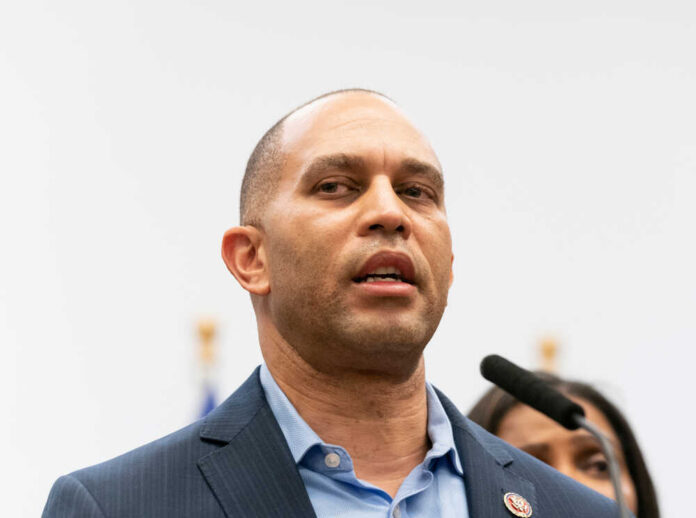
Jeffries’ comments came during a press appearance with the Congressional Black Caucus, where he called the ruling “unacceptable” and described the majority as an “illegitimate” bloc. In later remarks, including a podcast interview, he argued the decision fits a pattern of vote suppression and portrayed the Court as politically captured. Trump and allied conservative voices responded by framing Jeffries’ language as an attack on judicial legitimacy—an accusation that carries weight because public trust in major institutions has already been fraying.
What the Supreme Court Ruled—And Why It Matters
The dispute traces to Section 2 of the Voting Rights Act of 1965, which prohibits racially discriminatory voting practices and has long been used to challenge redistricting maps. The Court’s decision in Louisiana v. Callais, issued by a 6–3 conservative majority, reportedly weakened Section 2’s force in redistricting disputes. That outcome is central to Democratic messaging about civil-rights backsliding, while Republicans emphasize the Court’s role in applying statutory text and constitutional structure as written.
Because redistricting shapes political power for a decade at a time, even technical legal changes quickly become political weapons. Democrats argue narrowed enforcement reduces protections for minority voters; Republicans counter that elections should be governed by clear rules rather than shifting standards. The available reporting does not provide granular detail on the Court’s reasoning beyond the practical effect on Section 2 enforcement. That limitation matters because public “legitimacy” claims often outrun what the decision actually says.
The “Trump Court” Argument Collides With Institutional Reality
Jeffries repeatedly referred to the Court as the “Trump Court,” pointing to Trump’s three judicial appointments that helped form the current 6–3 majority. That framing is politically potent, but it also blurs a foundational point: justices hold life tenure and are not supposed to answer to party leaders. Conservatives see the “illegitimate” label as a step toward normalizing court-packing or coercive “reforms,” while liberals view it as an alarm about outcomes they believe undercut civil-rights protections.
The hypocrisy charge is also part of the story. Some coverage highlights that Trump criticized the judiciary earlier in 2026, reportedly calling the Court “weaponized and unjust” in a separate context. That history gives Jeffries’ allies a ready counterpunch, but it doesn’t resolve the core problem: when leaders of either party delegitimize courts primarily because of disliked rulings, they train voters to treat law as politics by other means. That dynamic accelerates polarization and weakens civic stability.
Impeachment Talk and the Midterm Incentives Behind It
Headlines about Trump calling for Jeffries to be “impeached” reflect the rhetorical temperature of 2026 politics, but the practical pathway is murky. Jeffries is the House Minority Leader, and impeachment is generally aimed at federal civil officers; the reporting frames Trump’s posture as an “impeachment-like” demand and a public challenge rather than a realistic legislative program. With Republicans controlling both chambers, the episode still functions as a pressure campaign over tone, not a formal disciplinary process.
Trump Calls for Hakeem Jeffries to Be Impeached for Bashing 'Illegitimate' Supreme Court: 'Why Not?' https://t.co/ng9rvpYbuC pic.twitter.com/8WLluFDe0w
— Mediaite (@Mediaite) May 3, 2026
The near-term impact is straightforward: both sides get a mobilization issue ahead of midterms, with Democrats focusing on voting-rights fears and Republicans focusing on institutional respect and constitutional order. The longer-term risk is that constant “illegitimate” branding becomes the default response to any major ruling, driving more Americans—left and right—to conclude the system is rigged by elites. When that cynicism spreads, it becomes harder to govern, harder to compromise, and easier for partisan actors to justify extreme measures.
Sources:
Donald Trump Wants Everyone (But Him) To Respect The Supreme Court’s Legitimacy
Trump Just Laid Waste to Hakeem Jeffries After His Comments Calling SCOTUS ‘Illegitimate’
Trump slams Jeffries over SCOTUS comments