
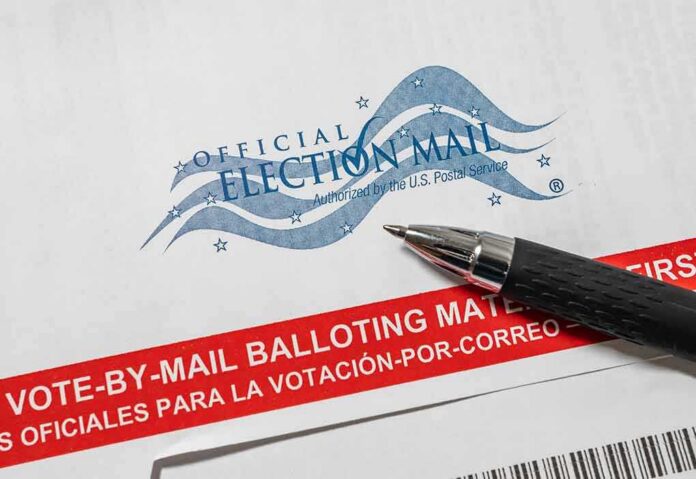
Maine closed an inquiry into 498 absentee-ballot return envelopes that ended up at a Maryland nonprofit without explaining how they got there, leaving a gaping hole in election chain-of-custody records.
Story Highlights
- Officials recovered 498 blank Maine absentee return envelopes from a Maryland nonprofit.
- Maine’s Attorney General closed the case without determining why the shipment was redirected.
- UPS records were not obtained because investigators declined to seek a subpoena.
- The nonprofit specializes in designing vote-by-mail materials used by election offices.
What Investigators Found — And What They Did Not
Maine’s records show law enforcement recovered 498 blank absentee-ballot return envelopes from the Center for Civic Design in Maryland. A state detective retrieved the boxes from a storage unit, and the recipient-side employee said the envelopes were not accessed while held there. The Maine Attorney General’s office later closed the matter. The closing memo said any reason for the redirection remained speculative, and that the file would stay closed unless new facts emerged.
Officials did not secure shipping records from United Parcel Service. Investigators said the carrier wanted a subpoena, but the Attorney General’s office judged there was not enough information to issue one. That decision left a clear gap. Without a bill of lading or scan history, the state cannot show who ordered the reroute, when it happened, or why the election materials were sent to Maryland instead of a Maine destination.
How The Envelopes Matter To Election Administration
Absentee return envelopes are not ballots, but they are vital election materials. Clerks use them to receive marked ballots and to verify voter identity details. The United States Election Assistance Commission says officials must log custody for mailed-ballot materials at each step, including receipt from printers, storage, transport, and sorting. The commission also advises verification of returned envelopes against voter records to prevent errors or misuse. A break in custody weakens that paper trail.
Public reporting identifies the Maryland recipient as the Center for Civic Design. The group publishes templates and guidance for mail-ballot envelopes and says its mission is to cut voter errors that lead to rejected ballots. That background explains why the group handles envelope designs. It does not, by itself, explain why nearly 500 Maine return envelopes—specific to a live election cycle—were shipped to a non-government location out of state, nor who directed that move.
What Maine Officials Said And Did During 2025
During fall 2025, Secretary of State Shenna Bellows addressed several mail-ballot handling issues, including missing packets tied to an Ellsworth shipment and a separate delivery error to a Newburgh home. She said her office referred enforcement questions to the Attorney General, who is the proper authority to bring any legal action for violations. Those steps fit standard roles. But the distinct envelope shipment to Maryland remained unresolved when the Attorney General closed the file.
Maine’s own guidance explains absentee processing and tracking. State voter data tools show when requests are issued and when ballots are returned, which helps the public see activity by municipality. For overseas and military voters, Maine directs the use of standard envelopes with a facing sheet to speed postal handling. These references show the state has rules and systems. The unanswered redirection of return envelopes sits outside those norms and procedures.
Why The Chain-Of-Custody Gap Matters Now
Election chain-of-custody is a guardrail, not a partisan talking point. It protects every voter by documenting who had what, when, and where. The federal election commission’s best practices urge officials to record transfers of mailed-ballot materials and to secure storage and transport at each handoff. When hundreds of return envelopes travel to an unplanned, out-of-state stop, and no one can show how or why, that breaks the record and invites preventable doubt about process integrity.
President Trump’s administration has pressed states to harden election systems, but election offices run the day-to-day work. Maine’s unresolved detour shows why state leaders must demand complete shipping logs from vendors and carriers, require written authorization for any reroute, and audit custody records before closing files. Those are simple, common-sense steps. They defend every lawful vote, stop sloppiness, and shut the door on games with the rules—no excuses, no mystery shipments, and no more closed cases without answers.
Sources:
themainewire.com, robinsonreport.substack.com, maine.gov, wmtw.com, wgme.com, absenteeballotrequest.sos.maine.gov, x.com, ground.news, civicdesign.org, brennancenter.org