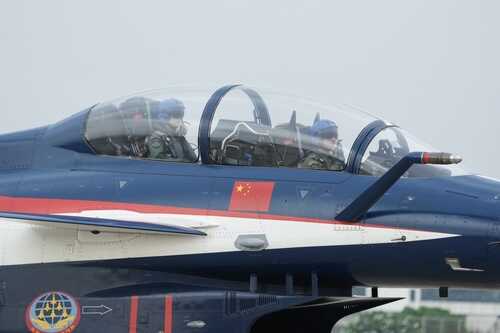
China’s new J-35 stealth fighter aims to challenge U.S. military dominance, sparking defense concerns.
Story Highlights
- China’s J-35 challenges U.S. carrier dominance with advanced stealth capabilities.
- Incorporates cutting-edge technology for undetected operations and air superiority.
- Potential threat to U.S. assets in the Indo-Pacific region with extended reach.
- J-35’s development signifies China’s growing military prowess and strategic ambitions.
China’s J-35: A New Era in Naval Aviation
China’s introduction of the J-35 stealth fighter marks a significant advancement in its naval aviation capabilities. The fighter’s angular fuselage, internal weapons bays, and radar-absorbent materials contribute to a reduced radar cross-section, enabling it to approach undetected for air superiority, ground-attack, and suppression of enemy air defenses (SEAD) missions. These features position China to challenge U.S. carrier dominance in the Indo-Pacific region.
The J-35 integrates PL-15 missiles and is powered by two WS-19 engines, allowing for a maximum takeoff weight near 30 tons. This design is optimized for electromagnetic catapults on carriers such as the Fujian, ensuring seamless integration into China’s expanding carrier fleet. The aircraft’s stealth technology and advanced avionics enhance its operational capabilities, making it a formidable adversary in contested regions.
Many have been focusing
on Russian air defenses and radar failures in Venezuela.Far less attention has gone to the Chinese systems that failed.
China supplied between 9 and 12 JY 27 so called anti stealth radars, marketed as capable of detecting the F 35.
Turns out, they… pic.twitter.com/RAF0tPhpT0
— Open Source Intel (@Osint613) January 5, 2026
Strategic Implications for U.S. Military
The J-35’s development underscores China’s strategic ambitions and its desire to project power beyond its shores. With a detection range exceeding 200 km, the J-35 poses a potential threat to U.S. assets within a 1,000 km radius. This capability not only strengthens China’s anti-access/area denial (A2/AD) strategies but also challenges the U.S. military’s ability to operate freely in the region.
The aircraft’s introduction comes amid heightened tensions in the South China Sea and Taiwan Strait, where China seeks to assert its influence against U.S. presence. The J-35’s stealth features and carrier compatibility offer a tactical edge, allowing China to enhance its blue-water navy operations and potentially shift the balance of power in favor of Beijing.
Expert Opinions and Future Outlook
Experts acknowledge the J-35 as a significant leap in China’s military aviation, yet they remain cautious about its unproven real-world capabilities. The durability of its engines and stealth coatings, particularly in maritime conditions, remains under scrutiny. However, the aircraft’s development reflects China’s determination to achieve indigenous propulsion independence and reduce reliance on foreign technology.
In the long term, the J-35 complements the existing J-20 stealth fighters, collectively eroding the U.S. air and naval edge as China continues to refine its military technologies. As Beijing enhances its aerial capabilities, allies in the region may feel pressured to upgrade their own defenses to keep pace with China’s rapid advancements.
Sources:
China J35/J35A Stealth Fighter Production Hangars
China Debuts Fifth-Generation Stealth Fighter
China’s J-35 Fighter Summed Up in Just 4 Words