

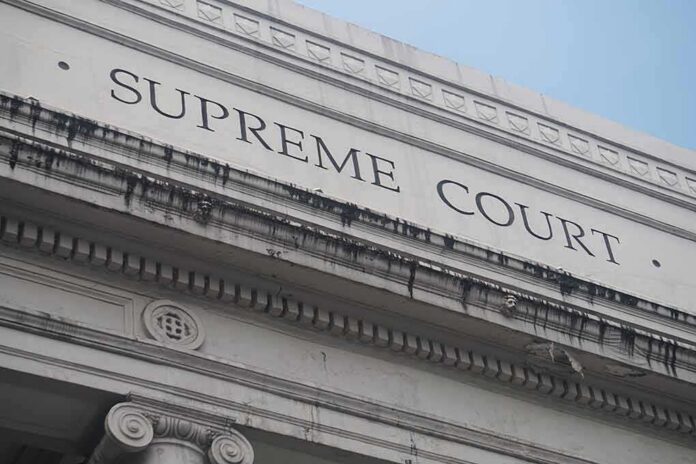
The Supreme Court will decide whether President Trump can use federal law to shut off asylum access at the border for a defined group of illegal entrants.
Story Snapshot
- The Supreme Court granted review of the challenge to Proclamation 10,888, setting up a major border ruling.
- The administration says immigration law lets the president suspend entry and categorically pre-deny asylum for covered entrants.
- Lower courts said the policy unlawfully replaces Congress’s procedures and cannot categorically deny asylum.
- The Court will also decide whether federal law blocks classwide injunctions against the policy.
What The Supreme Court Agreed To Decide
On November 13, 2026, the Supreme Court accepted Mullin v. Refugee and Immigrant Center for Education and Legal Services, a case that targets President Trump’s border order known as Proclamation 10,888. The case asks whether immigration law lets the president suspend entry and cut off access to asylum for people covered by the proclamation. The Court also agreed to review whether a federal statute limits courts from issuing broad, classwide injunctions in this context. The ruling will shape border authority heading into 2027.
The administration based its order on a law that lets presidents suspend entry of certain noncitizens when their entry would harm United States interests. The government’s Supreme Court filing says that when the president lawfully suspends entry, agencies may treat covered border crossers as inadmissible and categorically pre-deny asylum to avoid release into the country. The filing says the proclamation is formal, published policy, not an informal practice, and it ties fast removal to the entry suspension’s legal effect.
How Lower Courts Framed The Limits
Two lower courts ruled against the policy. A federal district judge said neither the Constitution nor immigration law allows the president to replace Congress’s detailed removal system or to suspend the right to apply for asylum. The United States Court of Appeals for the District of Columbia Circuit affirmed, saying the law gives presidents some discretion but does not allow categorical denial of asylum or removal under procedures “of his own making”. Those rulings paused core parts of the program while appeals moved forward.
Challengers argue that Congress wrote clear asylum rules that apply to people already inside our borders, even if they entered unlawfully. They say suspending “entry” does not erase the separate statutory right to apply for asylum once present, and that fast-track expulsions under the proclamation bypass screening for persecution or torture that Congress required. Advocacy summaries of the record describe returns of families without chance to raise those protection claims, which they call unlawful under the statute.
The Administration’s Statutory Theory And Stakes For Border Control
The government’s brief answers that Congress granted broad entry-suspension authority, and that authority reaches categories, not just individuals. It says the proclamation and guidance legally bar access to provisions that would otherwise keep covered entrants in the country, including asylum processing that results in release. That, the government argues, restores control, deters illegal crossings, and prevents cartels from exploiting loopholes in processing rules that overwhelmed border officers in recent years. The Supreme Court’s review gives the administration a chance to secure a clear rule on this power.
The docket underscores two stakes. First, whether categorical pre-denial can lawfully align with the asylum statute. Second, whether courts can issue sweeping injunctions that stop national security policies in one stroke. The Court’s order puts both issues on the table, signaling that the justices will weigh not only the president’s power but also the judiciary’s power to block it across the board during emergencies. Coverage highlights that this case could reset the ground rules for future border crises.
What It Means For Border Security, Separation Of Powers, And Common Sense
If the Court upholds the proclamation, Border Patrol and immigration officers would have firmer ground to stop release-first, review-later cycles that drew record surges. That outcome would back a simple principle: Congress gave presidents a tool to suspend entry when the nation’s interests demand it, and that tool must have real effect at high-volume borders. If the Court narrows the policy, Congress will need to act fast to close gaps the cartels and smugglers keep exploiting.
Supreme Court will hear the challenge to Trump's Proclamation 10888, which suspended asylum at the southern border. Lower courts ruled against the administration; restrictions stay in effect for now. Argument expected spring 2027. Follow for more.https://t.co/2ZHWuULQlt
— RTN Tony Adams (@tonyscakes8g) November 15, 2026
Either way, the case forces a hard question that conservatives have pressed for years: who sets the rules when law and reality collide at the line? The administration says elected leadership must be able to draw clear red lines when millions test the system. The challengers say every person must still get individual access to asylum procedures. The justices will decide how those two ideas fit together under the law, and how much room a president has to defend the border.
Sources:
charlotteobserver.com, supremecourt.gov, inquisitr.com, latimes.com, scotusblog.com