
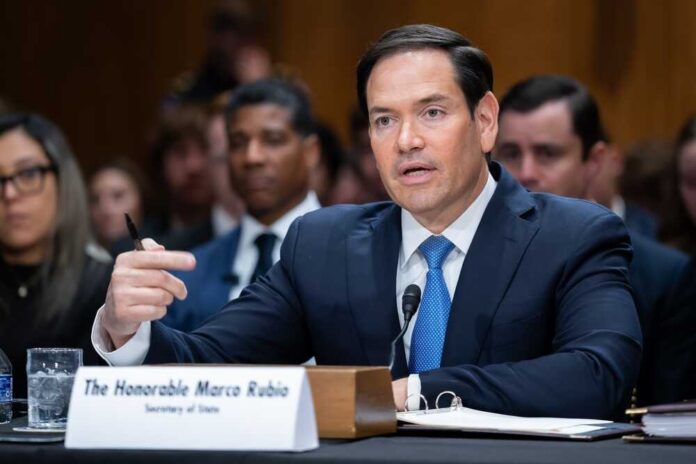
A high-stakes Senate hearing just revealed how the Trump–Rubio team plans to use Venezuela’s oil as leverage without spending a dime of American taxpayer money or bailing out the Maduro machine.
Story Snapshot
- Secretary of State Marco Rubio laid out a three-step U.S. strategy for Venezuela centered on stability, transition, and a free, friendly democracy.
- Rubio confirmed the administration is using sanctions on Venezuelan oil as a key pressure tool against the remnants of the Maduro regime.[1][4]
- A new mechanism would let sanctioned oil sell at full market prices, with revenue placed in a U.S.-supervised account for the Venezuelan people, not corrupt elites.[1]
- Rubio insisted American taxpayers will not foot the bill while also warning that more documentation is needed to prove the oversight system truly works.[1][4][6]
Rubio Outlines Clear Endgame for Post-Maduro Venezuela
Secretary of State Marco Rubio used his appearance before the Senate Foreign Relations Committee to put the Trump administration’s Venezuela policy firmly on the record: the target is a friendly, stable, prosperous, and democratic Venezuela, achieved through a deliberate three-phase strategy.[1][4][6] Rubio explained that the United States is first seeking stability, then a transition phase, and finally an end state with truly free and fair elections, not the rigged show votes Venezuelans endured under Nicolás Maduro’s socialist rule.[1] That framework matters for conservatives who want to know there is a coherent plan, not open-ended foreign meddling or endless “nation-building.” By defining the objective as a self-governing Venezuela that respects its own people and cooperates with the United States, Rubio signaled that this policy is about advancing American interests and regional security without buying into globalist fantasies or empowering a new leftist strongman.
Rubio’s testimony also directly addressed one of the biggest concerns for Trump voters tired of Washington adventurism: who pays. He stressed that the plan is not about spending American taxpayer dollars in Venezuela, but about using Venezuelan oil resources under strict conditions that benefit Venezuelans while keeping pressure on the failed Maduro apparatus.[1][7] For a base that remembers how past administrations poured billions into foreign projects while neglecting border security, energy independence, and middle-class families at home, this statement drew a clear line. The Trump–Rubio approach, as described in the hearing, attempts to use leverage the United States already holds—sanctions—rather than writing new checks or growing another bloated foreign aid bureaucracy.[1][4]
Sanctioned Oil as Leverage, Not a Lifeline for Socialism
Addressing how to turn sanctions into real-world leverage, Rubio confirmed that one of Washington’s most powerful tools is the existing quarantine on Venezuelan oil, which blocks sanctioned barrels from reaching the global market.[1][4] Instead of relaxing those sanctions as a giveaway, he described an arrangement where that oil can be sold only under strict terms: it moves at full market prices, not the deep discount that communist China had been exploiting, and the proceeds flow into a special account under U.S. oversight.[1] That account, Rubio testified, is intended to fund purchases that genuinely help the Venezuelan people—such as medicine, equipment, and key inputs for the energy sector—rather than lining the pockets of the old socialist elite or financing leftist security forces that once repressed protests.[1]
Rubio said that at the “front end” the United States will spell out what the oil money cannot be used for, and Venezuelan partners will have to submit monthly budget requests that are reviewed before funds are released.[1] He also testified that part of the very revenue stream will be devoted to paying for an audit system acceptable to the United States, with audits focused on the actual expenditures to verify compliance with those guardrails.[1] According to Rubio, Venezuelan counterparts have been “very cooperative” with this structure and have pledged to use substantial funds for humanitarian and economic needs.[1] For conservatives long skeptical of international deals, that level of design—monthly budgets, prohibited uses, and audits—shows at least an attempt to prevent the kind of corruption and waste that plagued prior globalist aid efforts, even if the proof of performance is still to come.
Oversight Promises, Verification Gaps, and What Conservatives Should Watch
Despite the detailed outline, Rubio’s testimony left important questions that matter to anyone who demands accountability before trusting another complex foreign mechanism. The hearing record and public clips do not identify who exactly controls the oversight account, what legal instrument authorizes it, or how enforcement will work if Venezuelan actors try to cheat.[1][4][6] The testimony also asserts that oil will move at market prices instead of China’s discount, but it does not include contracts, pricing data, or independent audits to confirm that Venezuelans, not Beijing, are truly gaining from the shift.[1] For a movement burned by opaque trade deals and shadowy multilateral arrangements, those missing pieces are a red flag.
Rubio’s remarks further suggested that this sanctions-and-oversight approach is part of a broader ladder of pressure that included nonmilitary tools first, with any military option reserved only after “exhausting every other option” to remove Maduro.[2][7] That sequencing aligns with a conservative preference to use economic leverage and diplomacy before risking American lives, while still keeping hard power on the table when tyrants threaten regional security. Still, the hearing did not present independent testimony from sanctions-enforcement experts, Venezuelan auditors, or financial intermediaries to validate that the oil-revenue mechanism can truly shut out corruption and black-market diversion.[1][4][6] As the Trump administration executes this policy, vigilant conservatives will want Congress to obtain the written testimony, licensing documents, and real audit trails Rubio referenced, ensuring this tool punishes what is left of the Maduro system rather than becoming yet another unaccountable global scheme hidden from the American people.
Sources:
[1] YouTube – Secretary of State Marco Rubio Testifies at U.S. Senate
[2] YouTube – Secretary Rubio testifies before the Senate Committee on Foreign …
[4] Web – [2026-01-28] U.S. POLICY TOWARDS VENEZUELA – Hearing
[6] Web – Marco Rubio Confirmation Hearing Secretary of State – Rev
[7] YouTube – Secretary Rubio testifies before the Senate Committee on Foreign …