

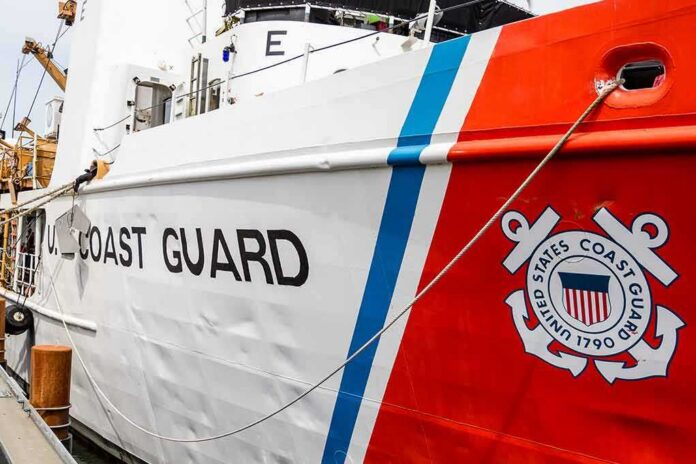
A packed makeshift boat carrying 66 people was stopped in the Mona Passage, and every person aboard was safely removed and later repatriated, according to the U.S. Coast Guard.
Story Highlights
- Coast Guard crews interdicted a crowded makeshift boat northwest of Aguadilla, Puerto Rico.
- All 66 people aboard were safely removed and later repatriated to the Dominican Republic.
- Most said they were from the Dominican Republic or Haiti; two said they were from Romania.
- The Mona Passage remains a high-risk route that smugglers exploit and U.S. forces patrol.
Coast Guard Interdiction Stops Risky Voyage Near Puerto Rico
The United States Coast Guard reported that a surveillance crew spotted a makeshift boat Tuesday morning northwest of Aguadilla, Puerto Rico. The cutter Heriberto Hernandez responded and interdicted the vessel in Mona Passage waters. Crews safely removed all 66 people from the unsafe craft. Coast Guard officials said the group was later repatriated to the Dominican Republic and transferred to Dominican Navy authorities on September 11, 2025.
The Coast Guard release detailed who was aboard. Officials said 48 people claimed Dominican nationality, including 41 men and seven women. Sixteen people claimed Haitian nationality, including 13 men and three women. Two men said they were from Romania. The agency described the trip as an “unlawful migration vessel voyage.” A trade journal that covers maritime security reported the same key facts and the safe removal of all 66 people.
Repatriation and the Law-and-Order Mission at Sea
Coast Guard crews repatriated the 66 people to San Pedro de Macoris, Dominican Republic, where Dominican Navy authorities received them. That process follows long-standing maritime practice: save lives at sea, remove people from unseaworthy boats, and return them when the law requires it. The mission protects our borders, deters smugglers, and upholds order without needless risk to crews or passengers who are often sent out on dangerous boats.
Officials say the Mona Passage, a roughly 90-mile stretch between the Dominican Republic and Puerto Rico, is a historic hot spot for unlawful crossings. Department of Homeland Security testimony described heavy traffic in the early 2000s, with thousands attempting the route each year. U.S. policy and better coordination have focused on interdiction and deterrence to reduce deaths and block smuggling networks that profit from desperate people and fragile boats.
Why This Matters for Border Security and Public Safety
Border pressure does not stop at the land frontier. Smugglers push people into the Caribbean on overloaded, homemade craft. That puts lives at risk and strains first responders. Interdictions like this one show a working shield at sea. Crews act fast, save lives, and enforce the law. That aligns with a simple standard most Americans support: secure borders, humane rescues, and clear consequences for unlawful voyages that threaten safety and sovereignty.
WATCH: A makeshift boat packed with 66 migrants is intercepted by the U.S. Coast Guard in the Caribbean, with aerial footage capturing the vessel as crews move in to assist those onboard.
The Coast Guard says the vessel was stopped Friday in the Mona Passage, a stretch of water… pic.twitter.com/BnWQkrPG9M
— Fox News (@FoxNews) October 20, 2026
Coast Guard enforcement in the Mona Passage also supports a broader strategy our readers expect: stop unlawful entry earlier, disrupt smuggling routes, and return people quickly when the law allows. That helps reduce downstream costs for communities, courts, and hospitals, and it backs our allies by coordinating returns. The cutter’s actions here, and the safe outcome for all 66 people, reflect that firm but fair approach on the water.