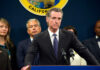
California’s emergency election plan for U.S. House redistricting faces chaos and legal challenges, sparking intense debate.
Story Highlights
- California Democrats plan an emergency election to counter Texas Republican redistricting.
- The move bypasses California’s independent redistricting commission.
- Local officials face logistical and legal challenges without a scheduled election.
- The situation could reshape the national balance of power in the U.S. House.
California’s Response to Texas Redistricting
In a direct response to Texas Republicans’ mid-decade redistricting, California Democrats are planning an emergency election to redraw U.S. House districts. Governor Gavin Newsom has expressed support for the initiative, which he describes as a measure to counter what he views as partisan advantages gained through Texas’ redistricting. The plan has not been formally scheduled, creating uncertainty for local officials. This move bypasses California’s independent redistricting commission, a significant departure from established norms.
California’s plan involves nearly 23 million voters across 58 counties, highlighting the unprecedented scale of this effort. Supporters such as Governor Gavin Newsom, Speaker Emerita Nancy Pelosi, and California Democratic Party Chair Rusty Hicks argue that urgency is driven by Texas Republicans’ mid-decade redistricting, which they say could result in additional GOP-held seats, similar to a strategy employed in Texas in 2003. California’s reaction signifies a politically charged race to influence congressional representation, emphasizing the adversarial nature of state-level powers.
Logistical and Legal Challenges
The proposed emergency election has created logistical and legal dilemmas for California county officials. With no formal election scheduled, local election administrators face significant challenges in preparing for a potential large-scale election. The Secretary of State’s office has begun consultations with county officials, despite the lack of a formal call for an election. This situation raises concerns about compliance with federal election law deadlines, particularly regarding military and overseas ballots.
In recent public statements, Governor Newsom and Speaker Emerita Nancy Pelosi characterized the move as a defense of democratic principles, using the term “power grabs” to describe the Texas redistricting effort. Meanwhile, California GOP Rep. Kevin Kiley plans to introduce federal legislation to prohibit mid-decade redistricting nationwide. These developments highlight the heightened partisan tensions and national media attention surrounding this issue.
Potential Impact on National Politics
If successful, the emergency redistricting could eliminate up to five GOP-held House seats in California, significantly altering the national balance of power. Election law analysts such as Richard Hasen, professor at UCLA School of Law, and Michael Li, senior counsel at the Brennan Center for Justice, caution that the move could set a precedent for other states to engage in mid-decade redistricting, which they say could undermine the principle of decennial, nonpartisan map-drawing. The situation could erode public trust in the electoral process due to perceived partisan manipulation.
California Plans Election in US House Seats Standoff With Texas https://t.co/AHGyz7JUx1
— Clark Devoe (@newsjocky) August 8, 2025
The implications extend beyond California, as the U.S. House remains closely divided, making every seat critical for party control. The outcome of California’s emergency election could have national repercussions, influencing the composition of the largest delegation in the House. As the situation unfolds, stakeholders across the political spectrum are closely monitoring the developments.
Sources:
California Rushes to Plan Unscheduled Election
California Rushes to Plan Unscheduled Election in US House Standoff
Texas Democrats and California Redistricting
Governor Newsom Hosts Texas Officials