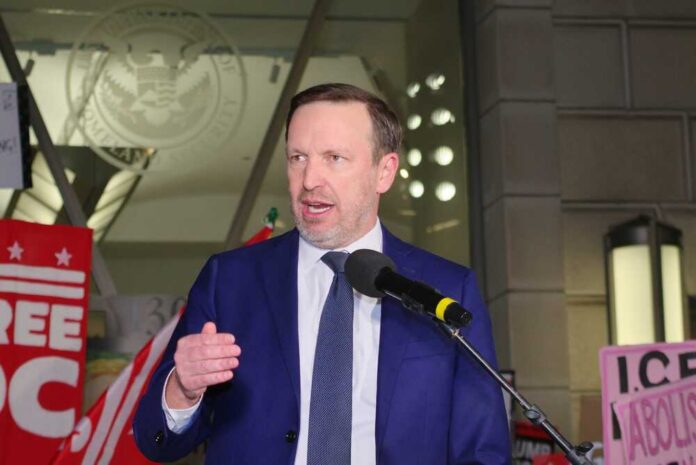
A sitting U.S. senator took his “Trump is a totalitarian” message overseas—raising fresh questions about whether America’s political fights are being exported to shape global pressure back home.
Story Snapshot
- Sen. Chris Murphy (D-CT) spoke at a progressive summit in Barcelona on April 18, 2026, accusing President Trump of a “totalitarian takeover” and “oligarchic capture” of U.S. institutions.
- Murphy’s Barcelona remarks echoed an October 2025 Senate floor speech that laid out what he described as a five-step plan to consolidate power over justice, media, law enforcement, spending, and elections.
- This highlights a growing trend: American leaders turning domestic disputes into international messaging campaigns—fueling distrust among voters who already think government serves insiders first.
Murphy’s Barcelona speech takes a U.S. fight to a global stage
Sen. Chris Murphy delivered remarks on April 18, 2026 at the Global Progressive Mobilisation Summit in Barcelona, portraying the United States as being “in the middle” of a “totalitarian takeover.” Murphy argued that institutions Americans normally rely on—courts, law enforcement, elections, and the press—are being pulled into what he called “oligarchic capture.” His central political goal was clear: rally transnational progressive attention and coordination around opposition to Trump’s second-term agenda.
Murphy’s overseas appearance matters less as a travel detail and more as a signal about strategy. When a senator frames U.S. governance as an emergency in front of foreign political allies, it can amplify domestic narratives through international media, NGOs, and party networks. Supporters see that as solidarity against authoritarianism. Critics see it as laundering partisan claims through global institutions—an approach that can deepen the sense, on right and left, that politics has become performance for elites.
The “five-step plan” claim originated in a 2025 Senate floor warning
Murphy’s Barcelona message was not a one-off. In October 2025, he delivered a Senate floor speech and accompanying materials arguing that Trump and aligned officials were pursuing a structured plan to consolidate power. Murphy’s outline focused on five areas: weaponizing the justice system, pressuring or censoring media, militarizing federal law enforcement, seizing leverage through federal spending, and manipulating elections. Multiple provided sources show Murphy repeating this framework consistently over time.
Murphy’s cited examples in 2025 included a claimed indictment of former FBI Director James Comey, alleged regulatory pressure against Jimmy Kimmel’s show, and what Murphy described as a political bargain involving New York City Mayor Eric Adams. He also pointed to unilateral grant cancellations in Democratic-led states and political demands around mid-cycle redistricting. Those specifics are presented in the research as Murphy’s assertions and narrative; the supplied materials do not include independent documentation resolving each allegation.
What’s verifiable here—and what remains rhetorical
The most verifiable elements are the public record of Murphy’s speeches, his office’s published statements, and the reported fact that he delivered remarks in Barcelona. Those sources demonstrate his claims of a “totalitarian takeover” and his contention that institutional guardrails are failing. What is less clear from the provided research is the evidentiary basis for each specific accusation. Without outside corroboration included here, readers should separate documented statements from proven misconduct.
Why this resonates with voters who feel the system is rigged
Murphy’s rhetoric lands in a country where many Americans—conservative and liberal—already believe the federal government prioritizes insiders over citizens. For conservatives frustrated by “deep state” behavior and unelected influence, Murphy’s framing can look like another attempt to delegitimize elected outcomes by escalating drama abroad. For liberals who fear politicized enforcement, Murphy’s warnings validate their anxieties. Either way, the fight reinforces a shared suspicion: institutions are being used as weapons.
The political impact: internationalized messaging, hardened distrust at home
In the near term, Murphy’s overseas speech is likely to energize activists, fundraising, and messaging on both sides heading toward 2026 political battles. In the long term, repeatedly labeling normal democratic competition as “totalitarian” risks lowering Americans’ confidence in elections, courts, and law enforcement—especially when evidence is debated and enforcement decisions look partisan. If Congress wants to reduce national temperature, it will need transparent oversight that prioritizes facts over slogans.
Repugnant Liar Sen. Chris Murphy (D-Bag) Went Overseas to Blast Trump's 'Totalitarian Takeover' https://t.co/MPyShBLRL4
— Joe (@JoeC1776) April 19, 2026
For a public exhausted by inflation memories, culture-war conflicts, and years of institutional mistrust, the takeaway is not that one party is automatically right—it’s that leaders are increasingly incentivized to escalate. Murphy’s choice to broadcast his case in Barcelona underscores how American politics now operates across borders. Voters who want stability should demand specifics, documentation, and measurable accountability—because accusations that big carry consequences for a republic built on trust in law, not personalities.
Sources:
Murphy: Trump authoritarian takeover government
Murphy: Trump’s authoritarian takeover isn’t coming — it’s here