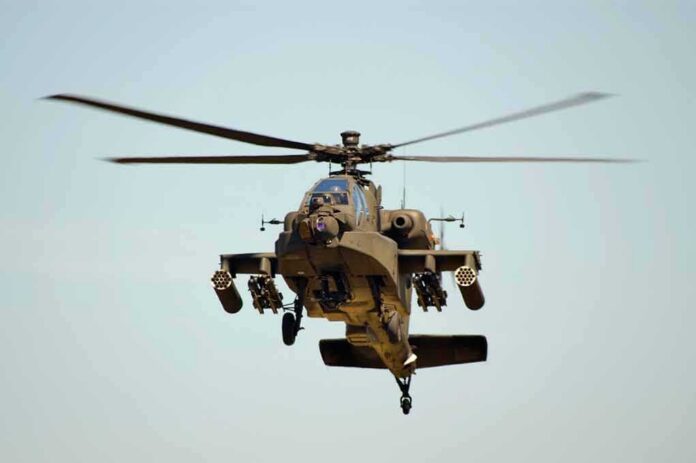
An Iranian strike on a U.S. Army helicopter in the Strait of Hormuz forced President Trump to order new military action, and eight months later America and Iran are still stuck in the same standoff.
Story Snapshot
- Iran shot down a U.S. Apache helicopter near Oman’s coast in June; both pilots survived and were rescued at sea.
- President Trump ordered retaliatory strikes on Iranian air defenses, radar sites, and ground control facilities.
- A 14-point memorandum was supposed to end the war and open the Strait of Hormuz, but it never became a final deal.
- Iran has repeatedly rejected U.S. terms as “excessive,” demanding sanctions relief, frozen assets, and control over Hormuz.
- As of August, Iran says talks have made “absolutely no progress,” and both sides remain at a standstill.
Iran Shoots Down American Helicopter, Trump Demands Response
President Trump said Tehran shot down a U.S. Apache helicopter in the Strait of Hormuz, telling reporters the United States “must” respond. Reuters and the Associated Press reported both pilots survived and were uninjured after the crash near Oman’s coast during a routine patrol. A Navy surface drone found and rescued the crew from the water, while U.S. Central Command initially said the cause was under investigation.
Central Command later confirmed it struck Iranian air defense systems, ground control facilities, and surveillance radar sites. Officials called the operation a “measured response” to attacks on American troops and commercial ships in the region. Reuters, BBC, and NBC all reported the strikes independently, confirming this was a real military response, not just tough talk from the White House.
A Ceasefire Framework Emerges, Then Starts to Crack
Days after the strikes, negotiators produced a 14-point memorandum of understanding meant to be signed in Switzerland. The document declared an “immediate and permanent termination of military operations” and gave both sides 60 days to negotiate a final settlement. It also addressed the Strait of Hormuz directly, promising the vital waterway would stay open to commercial shipping.
That framework gave the administration something concrete to point to instead of vague promises. But a memorandum is not a finished treaty. Reuters reported the deal remained a temporary pause with a countdown clock, not a signed final agreement, leaving plenty of room for Iran to stall or walk back commitments once the pressure eased.
Iran Digs In With a Long List of Demands
Iran’s government has consistently rejected the terms it says Washington keeps pushing. Iranian state media called the American conditions “excessive demands” and said accepting them would amount to “surrender.” Tehran’s Foreign Ministry spokesman said Iran’s counteroffer requires ending the U.S. naval blockade, releasing frozen Iranian assets, and stabilizing the region, including Lebanon.
Iran has piled on more conditions over time: war reparations, full sovereignty over the Strait of Hormuz, an end to sanctions, and a permanent halt to strikes on its allies. In August, an Iranian source told Reuters there had been “absolutely no progress” reviving the interim deal, accusing Washington of violating the agreement within 48 hours before pulling out entirely.
A Fragile Truce With No Finish Line
Iran’s Supreme National Security Council later listed six conditions for reopening Hormuz, including an end to all U.S. threats, a permanent halt to attacks on Iran and its allies, and unconditional release of frozen funds. Every round of talks seems to add new demands rather than settle old ones, which is exactly the pattern that has kept this conflict frozen since spring.
By August, Iran was threatening a new offensive in the Strait of Hormuz if diplomacy failed, while the U.S. ruled out extending the ceasefire indefinitely. Reuters and BBC both described the truce as fragile and strained, meaning any new incident, like another helicopter downing, could unravel the whole arrangement overnight.
Why This Matters for American Strength
President Trump acted decisively when Iran attacked American forces, hitting back at military targets instead of standing by. That is the kind of resolve conservatives have wanted from Washington for years, a stark contrast to the previous administration’s pattern of appeasement toward Tehran. The problem is not American weakness. The problem is a regime in Tehran that keeps moving the goalposts.
Analysts have compared the repeated claims of a coming deal to “crying peace deal” one too many times, and that skepticism is fair. But the underlying facts are clear: Iran attacked first, America responded with force, and Iran has refused every reasonable framework since. Until Tehran stops treating negotiations as a stalling tactic, this standoff will stay exactly where it is now, stalled.
Sources:
military.com, independent.co.uk, nbcnews.com, wsj.com, reuters.com