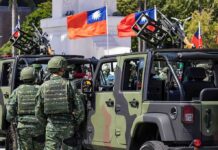


Taiwan’s leaders just set plans to field more than 200,000 home-built drones, betting mass and speed can help stop a Chinese invasion.
Story Highlights
- Taiwan advanced a special drone budget near NT$210 billion over six years to buy domestic systems.
- Government targets include more than 208,000 coastal attack drones and other uncrewed systems.
- Lawmakers preserved about NT$63.4 billion in annual drone funding while debating the larger special bill.
- Parliament weighed rival plans, with one vote rejecting the government’s single large package for staged yearly spending.
Taiwan’s Drone Surge Moves From Concept To Funded Programs
Taiwan’s Cabinet proposed a six-year, NT$210 billion special budget to buy domestically produced drones. Officials said the plan covers August 2026 through 2031 and aims to harden the island against attack with large numbers of uncrewed systems. The move follows earlier annual funding that kept NT$63.4 billion for drones intact despite broader cuts, signaling cross-party acceptance of drones as a core defense layer. Leaders cast massed drones as a way to raise costs for any amphibious assault.
The Ministry of National Defense laid out targets that stress volume. The government’s latest special bill described 208,200 coastal attack drones, 1,446 coastal reconnaissance drones, and 1,320 uncrewed surface vessels to be funded over the six-year window. A separate analysis and industry briefs have referenced totals above 210,000 for military use when combining lines of effort. These systems fit an asymmetric approach that favors cheap, expendable platforms to overwhelm invading forces near Taiwan’s shores.
Legislative Fights Shape How Fast The Drones Arrive
Budget mechanics became a battlefield of their own. Taiwan’s opposition-led parliament rejected the Cabinet’s T$210 billion special-bill format in one vote and advanced a rival plan with annual appropriations near T$40 billion instead. Even with that clash, lawmakers had already passed the 2026 general budget that preserved the full drone line at about NT$63.4 billion, keeping near-term buys on track while leaders argue over the longer, larger package. That split approach keeps procurement moving but slows scale-up.
Presidential and Cabinet leaders urged a bigger, steadier commitment. Before the vote, President Lai Ching-te pushed for the special bill, saying Taiwan must show resolve to pass the T$210 billion drone plan to strengthen deterrence now, not later. Cabinet action in June restated the same goal and dollar figure, tying the special act to domestic production over six years. Supporters argue that one large framework secures suppliers, speeds factory lines, and avoids gaps that yearly fights can create.
Why Massed, Home-Built Drones Fit The “Hellscape” Strategy
Defense thinkers have called for a “hellscape” that uses many small, smart drones across air and sea to wreck an invasion’s timing and tempo. Research from a United States think tank argued Taiwan needs mass and flexibility it can afford, and should pair drones with mines, missiles, and sensors to box in landing forces. Local reporting and academic work describe drones as a key asymmetric tool that raises the cost to China without matching tank for tank or jet for jet. The focus is quantity, survivability, and speed of replacement.
Industrial capacity is the hinge. Taiwan’s economic officials and industry trackers say the island is aiming for high-rate output and export potential by 2030, a sign that leaders want drone plants that can surge in a crisis. Government program lines have also paired military buys with support for a broader domestic drone sector, knitting supply chains that avoid China-sourced parts and build trust with partners. The goal is clear: make drones in Taiwan, in bulk, and keep them flowing during a fight.
What This Means For U.S. Interests And Conservative Priorities
Beijing’s threat is plain. Taiwan is moving to turn shorelines into kill zones using cheap, plentiful systems that can be built fast. For Americans who back peace through strength, this matters. A Taiwan that can blunt an invasion lowers the odds of a wider war that could drag in U.S. forces and spike energy and shipping costs. The plan also leans on private industry, not big, slow programs. That fits conservative calls for efficiency, local production, and strong borders backed by real tools, not slogans.
What To Watch Next: Scale, Training, And Staying Power
Watch whether the legislature locks in a multi-year special act or continues with year-by-year steps. Track real deliveries against the targets for 208,200 coastal attack drones and the other systems. Look for training that ties drones into coastal defense units and for proof that factories can surge and repair at wartime rates. Also watch how leaders shield command links from jamming and strikes. The bottom line is simple: numbers matter, but sustained numbers win. Taiwan is racing the calendar to get both.
Sources:
19fortyfive.com, taipeitimes.com, dset.tw, reuters.com, thediplomat.com, fapa.org, france24.com, focustaiwan.tw