
China’s military is tightening a quasi-blockade around Taiwan’s skies and seas, raising real risks for America’s security and economy.
Story Highlights
- Chinese forces are ramping air and sea pressure that looks like blockade practice, not routine drills.
- U.S. assessments say China is building tools to deter and, if needed, beat U.S. help to Taiwan.
- Congressional research calls a Taiwan invasion the region’s hardest, most dangerous military scenario.
- Some experts still judge full-scale war is not imminent, even amid “gray-zone” coercion.
Beijing’s Pressure Campaign Resembles Blockade Preparation
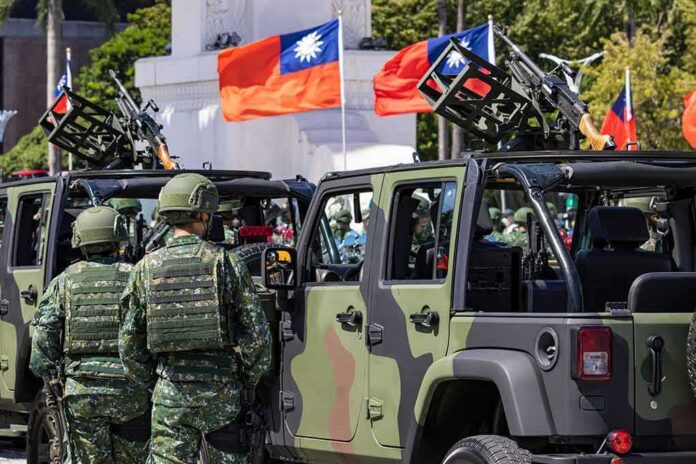
Reuters reported Taiwan’s defense ministry warned that China is “strengthening its control” over nearby sea and air, calling Beijing “unpredictable”. Reported patrols and incursions fit a pattern of pressure that limits Taiwan’s freedom of movement without an open attack. Regional coverage said recent drills focused on “joint blockade and control,” pointing to plans that could cut Taiwan’s trade lifelines and test U.S. resolve to keep vital sea lanes open. These moves risk a crisis, even without a formal invasion.
The Institute for the Study of War reported 181 Chinese military aircraft entered Taiwan’s air defense zone in September. That pace signals sustained coercion and practice for complex operations around the island. Such behavior normalizes Chinese presence, blurs warning signs, and makes a sudden squeeze easier. For American readers, this matters beyond maps. A blockade would shock global supply chains and hit U.S. factories and families through higher prices, fewer goods, and more dependence on rivals.
What U.S. Intelligence and Congress Say About the Risk
CNN’s coverage of the U.S. annual threat assessment said China is making “steady but uneven” gains in the very capabilities it would use to seize Taiwan and to deter or defeat U.S. help. That means longer-range missiles, air defenses, naval forces, and electronic warfare that complicate any rescue. The Congressional Research Service writes that an invasion would still be the riskiest campaign for China, requiring a cross-Strait assault and brutal urban fighting, but the danger to U.S. forces and allies would be severe.
The hard truth is this: even if Beijing prefers to avoid war, coercion can still break peace. Slow, grinding pressure can trap Taiwan, rattle markets, and drain U.S. credibility without a shot fired. That is how revisionist regimes test free nations. The more China practices control over the Strait, the harder and costlier it becomes to reverse that “new normal” later. Deterrence now is cheaper than crisis response later, for America and for our partners.
Not Inevitable War, But Rising Costly Coercion
U.S. reporting also notes Beijing likely prefers unification without force and does not see an attack as imminent. A Brookings study adds that while China uses coercive “gray-zone” tactics, conflict is neither imminent nor inevitable. Both points can be true at once. China may avoid a headline war while still choking Taiwan’s options. For conservatives, the test is classic: keep peace through strength, shore up supply chains at home, and refuse to let a communist regime set the rules of the sea.
Policy voices argue America’s long-standing “strategic ambiguity” has helped deter both a Chinese attack and a unilateral declaration of independence by Taiwan. That tool still has value. But ambiguity without hard power invites doubt. President Trump’s team must keep the Indo-Pacific loaded with ready forces, tighten joint planning with Japan and others, and speed defensive arms that raise the cost of Chinese coercion. Clear red lines, credible forces, and resilient U.S. industry are how you prevent miscalculation and protect American families.
Sources:
theamericanconservative.com, understandingwar.org, reuters.com, edition.cnn.com, washingtontimes.com, thediplomat.com