

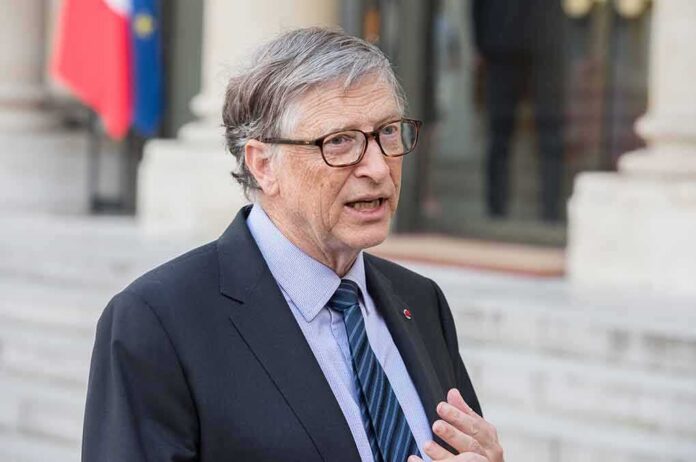
Bill Gates is urging airlines and governments to change flight paths to erase “just cloud” contrails, claiming big climate gains that the science still labels uncertain.
Story Highlights
- Gates says cutting long-lasting contrails could ease global warming by a notable amount.
- Scientists agree contrails can warm the planet, but the exact size of the effect has wide uncertainty.
- A real-world trial showed targeted routing cut visible contrails on test flights by about two-thirds.
- Experts warn avoidance can raise fuel burn and costs, so net benefits must be proven at scale.
What Gates Claimed And Why It Lit A Fire Online
Bill Gates released a video arguing that persistent aircraft contrails are “just clouds” but still warm the planet, and that airlines can avoid making them. He framed contrails as a major piece of aviation’s non‑carbon impact and suggested that cutting them could shave a meaningful share off warming. The claim touches a nerve. Many Americans distrust top‑down climate fixes from billionaires. They also want straight answers that do not empower unelected global players.
Scientists back the basic point that contrails are real ice‑crystal clouds made by jets and that their net global effect is warming, not cooling. The U.S. National Academies describes contrails as raising temperatures on balance, though the exact size of the effect is hard to pin down. That is the key tension. Gates pushes action now. Researchers caution that the numbers carry wide error bars and depend on weather, altitude, region, and time of day.
What The Evidence Shows About Contrails And Warming
Peer‑reviewed studies find that contrail ice crystals can trap heat by reducing outgoing longwave radiation, adding to warming. Major reviews say the net effect of contrails is warming, and that contrails plus related cloudiness can rival aviation’s carbon dioxide in impact when measured on certain timelines. At the same time, estimates vary. European and U.S. summaries report large uncertainty ranges for contrail forcing and temperature effects, which makes any single “percent of global warming” claim shaky.
A controlled field study tested whether airlines can actually avoid contrails. Researchers randomized outbound and return flights and used satellite images and tracking data. Avoidance flights produced four detectable contrails versus eleven for controls, a 63.6 percent drop. That proves feasibility in specific cases. It does not prove that system‑wide routing cuts total warming after you add in extra fuel burn, longer paths, or air‑traffic limits. Scaling it up safely and cheaply is the hard part.
Costs, Tradeoffs, And Who Decides The Rules
Changing altitude or route to dodge cold, wet air can mean higher fuel burn and more carbon dioxide. Airlines also face safety, congestion, and schedule pressures. The research community says the net climate benefit of avoidance depends on those tradeoffs and on reliable forecasts of contrail‑forming zones, which are still improving. Without clear, proven gains, a blanket mandate would look like another top‑down rule that raises ticket prices and hands more power to climate bureaucrats.
Gates’s branding of contrails as “just clouds” can sound dismissive to people who fear hidden agendas. But even groups that reject “chemtrail” claims agree on a simpler point: contrails are ordinary exhaust clouds that can warm the planet by slowing infrared cooling. The policy question is not whether contrails exist. It is who sets the targets, who pays the added costs, and whether the promised climate benefit beats the added fuel and delay. Those calls should rest on transparent data, not billionaire hype.
What A Responsible Next Step Looks Like Under President Trump
President Trump’s administration can keep control in American hands while testing facts in the open. Agencies can back larger, preregistered trials across regions and seasons, with airlines sharing fuel‑flow and routing data under strict privacy rules. Audits should measure both contrails and total emissions, and publish results for public review. That approach respects taxpayers, avoids mission creep, and stops global bodies from dictating flight operations to U.S. carriers.
JUST IN – Bill Gates releases an educational video on chem-trails vs. contrails: "Contrails are just clouds." He adds, "They are also a significant contributor to climate change… Eliminating them could cut up to 2% of all global warming." pic.twitter.com/9ofLO1vPyk
— Bioclandestine (@Bioclandestine7) October 9, 2026
Congress should block any rush to international mandates until evidence shows clear net benefits for climate, cost, and safety. If targeted avoidance works in specific weather windows at low cost, airlines will adopt it by choice. If not, Washington should not punish travelers and pilots for an uncertain gain. Conservatives can welcome real science while rejecting elite pressure to hand over our skies to global schemes long on promises and light on proof.
Sources:
thegatewaypundit.com, arxiv.org, telegraf.rs, pmc.ncbi.nlm.nih.gov, nationalacademies.org