
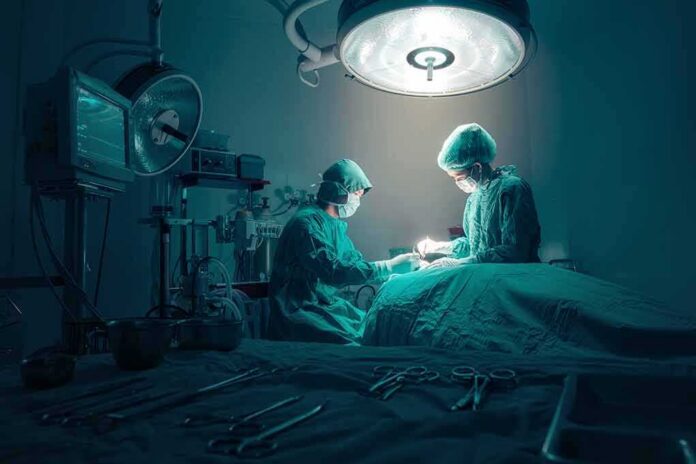
American surgeons traveled to Kyiv to rebuild shattered eyes and train local doctors, giving wounded Ukrainian soldiers a real path to healing and dignity.
Story Highlights
- U.S. eye surgeons performed reconstructive operations in Kyiv while training Ukrainian clinicians.
- Procedures rebuilt eye sockets and eyelids; some patients received cosmetic artificial eyes when vision was lost.
- Named surgeon Stuart Seiff operated on soldier Mykola Kasiuk after a land-mine blast.
- Doctors restored eye movement and used a skin graft to help eyelid protection in a key case.
Documented Mission: Surgery Paired With Training
Associated Press reporting describes a U.S.-Ukrainian medical mission that treated wounded soldiers in Kyiv and trained Ukrainian clinicians in complex eye reconstruction. The effort ran through Vision for Ukraine alongside the Christian Medical Association of Ukraine. Visiting surgeons focused on the face and eye area, where war injuries often destroy sockets, lids, and muscles. The team worked shoulder to shoulder with local doctors to pass on methods, tools, and planning for staged care as the war continues.
Reporters observed named U.S. and Ukrainian surgeons operating in a Kyiv hospital. They documented careful reconstruction to protect damaged eyes and restore as much function as possible. The teams fit artificial eyes for those who lost sight and needed a cosmetic match to the remaining eye. The mission’s blend of direct care and hands-on training aimed to build local capacity so Ukrainian staff can manage more complex cases after the visitors leave.
One Soldier’s Case: Rebuilding After a Land-Mine Blast
Surgeon Stuart Seiff, an oculoplastic specialist from San Francisco, operated on Ukrainian soldier Mykola Kasiuk. A land-mine blast blinded one eye and left only faint light in the other. Seiff focused on reconstructing Kasiuk’s socket and eyelid so the eye would be protected and able to move again. The case showed the mission’s priorities: stabilize, safeguard remaining vision, and set up options for later procedures if healing allows.
Contemporaneous reporting states doctors restored movement in Kasiuk’s injured eye and used a skin graft from behind his ear to help the eyelid protect it. That step matters because lids must close and guard the eye surface to prevent damage and infection. Journalists also noted cautious expectations on vision. Surgeons discussed possible future steps, like a corneal transplant, only after healing and careful review over time.
What These Operations Achieve—and What They Do Not
U.S. and Ukrainian teams rebuilt sockets, repaired eyelids, and addressed scarring that warped eye position. Those repairs can improve comfort, eye movement, and appearance. When vision cannot return, technicians in Kyiv produce artificial eyes that match the patient’s other eye. These prosthetics restore appearance but not sight. The available reports do not claim broad vision recovery, and they do not publish long-term acuity data for each patient treated during the mission.
Journalists also documented a box of prosthetic eyes brought from the United States and observed facial and eye-area procedures at Kyiv hospitals. The coverage confirms real surgeries, named doctors, and photographed cases. It does not quantify the full program scale, such as total patients, success rates, or one-year outcomes. That lack of totals is common in wartime reporting, where teams must work fast and often under threat while records remain private for patient safety.
Why This Matters to Americans
This story shows Americans stepping up with skill, not blank checks. Surgeons shared hard-won expertise, taught local staff, and helped wounded soldiers regain dignity after brutal attacks. That is a prudent model: targeted help, tight accountability, and training that leaves capacity behind. It respects taxpayers and supports a partner nation under fire without feeding endless bureaucracy or wasteful programs that do not deliver results at home or abroad.
The mission’s focus on sockets, eyelids, and prosthetics is practical and measurable. Rebuilt lids protect the eye. Restored movement improves daily life. Matched prosthetics help soldiers face families and work. These steps do not promise miracles, but they offer real progress. Surgeons were clear about limits and next steps. Some patients may qualify for later transplants, but only after healing proves it is safe and worthwhile. That careful path puts patient welfare first.
What Comes Next
Future reports could share de-identified results on eye movement, eyelid closure, socket strength, and later procedures. That would show which methods work best in war injuries and help Ukrainian teams plan care. For now, the record shows that American and Ukrainian doctors are rebuilding faces and protecting damaged eyes under fire. Their work gives soldiers a better chance to return to family life with strength and pride, even when full sight cannot be restored.