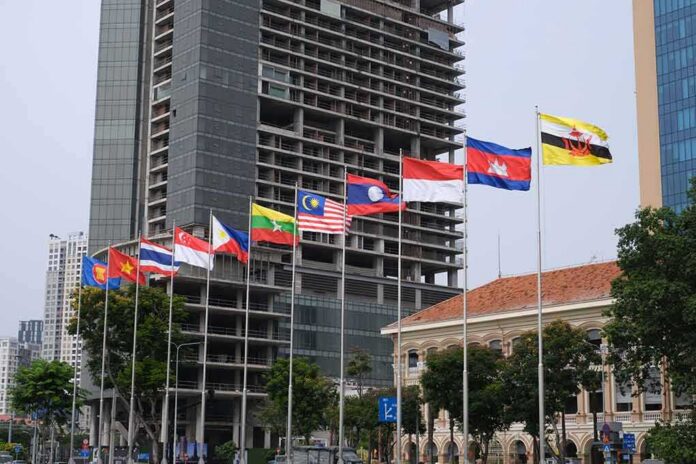
Ten years after a binding legal ruling rejected Beijing’s sweeping sea claims, Southeast Asian leaders face a simple test: will they finally act on it or let China keep pushing them around?
Story Highlights
- A 2016 tribunal voided China’s “nine-dash line” claims as inconsistent with sea law.
- The award is final and binding under the sea treaty, though China rejects it.
- Analysts urge ASEAN to reference the ruling and use smaller coalitions to move forward.
- Arbitration wins on paper often struggle to change behavior in hard-power disputes.
What The 2016 Ruling Actually Said And Why It Matters
The tribunal in The Hague ruled in 2016 that China’s “nine-dash line” claims do not match the United Nations Convention on the Law of the Sea, and are therefore invalid. The panel did not decide who owns islands, but it did settle key maritime rights questions. It found the treaty, not vague history, sets the rules for waters and seabeds. The ruling favored the Philippines on most points and stands as final and binding between the parties.
China’s government rejected the case and the decision, saying the tribunal had no right to hear it. That refusal left a gap between law and action on the water. Still, allies and partners marked the award’s clear holdings and legal force under the treaty. Australia called it unanimous, clear, and binding, and said the claims to “historic rights” have no basis under the pact. The legal baseline exists; the question is who will back it with steady policy.
The ASEAN Challenge: Consensus Rules And A Split House
Association of Southeast Asian Nations statements have often avoided direct mention of the award. A 2016 commentary noted the group left out any reference to the ruling, showing how consensus rules can blunt action when members disagree. Some states face heavy economic ties with China. Others, like Vietnam and the Philippines, press back. Vietnam, as chair in 2020, pushed statements that named the sea treaty as the basis for maritime rights.
Policy experts propose workarounds that fit ASEAN’s own tools. They suggest “minilateral” groups inside the bloc to move on tough issues when full consensus is not possible. That could let like-minded members cite the award, back joint patrols, and align fishing and energy policies without waiting for every capital. The goal is to defend rules while keeping ASEAN central and steady, rather than paralyzed.
Law Versus Power: Why Enforcement Lags And What Can Change
International arbitration often works well in commercial shipping, where parties want predictable outcomes. In political disputes tied to sovereignty or national pride, enforcement is weaker. Data show high global enforceability for arbitration in general, but lower rates in regions with limited support or strong pushback. In the South China Sea, the tribunal kept sovereignty questions off the table yet set firm guidance on maritime rights under the treaty. That leaves space for policy, not courts, to carry the ball.
14 nations unitedly reaffirm the arbitration ruling rejecting China's sweeping claims over most of the South China Sea.
This coinciding with the tenth anniversary of the ruling is more than a milestone.
The South China Sea is crucial to China from a military point of view,… pic.twitter.com/WUMtlrJnYH
— NWS Network (@NWS_Network) July 16, 2026
Practical steps can close the gap. ASEAN members can reference the award by name in joint or minilateral statements. They can file coordinated diplomatic notes using the ruling’s logic. They can run joint patrols and search-and-rescue drills to show presence. They can set shared rules for fishing and energy projects within treaty-based zones. Each action signals that law has weight, reduces miscalculation, and defends free seas that carry vital trade for the United States and its allies.
What This Means For America’s Interests And Values
Free navigation keeps prices lower and supply chains open. The United States relies on open sea lanes, not closed zones run by force. The ruling backs a rules-based order over “might makes right.” That aligns with American conservative values: clear rules, fair trade routes, and strong borders at sea. The Trump administration’s second term supports allies that defend treaty rights and resist coercion. A firmer ASEAN stance would meet law with action and deter creeping control without firing a shot.
Sources:
realcleardefense.com, en.wikipedia.org, sites.google.com, mfa.gov.cn, dfat.gov.au, iseas.edu.sg, dkiapcss.edu, thediplomat.com, dr.ntu.edu.sg, seo.goover.ai, hfw.com