

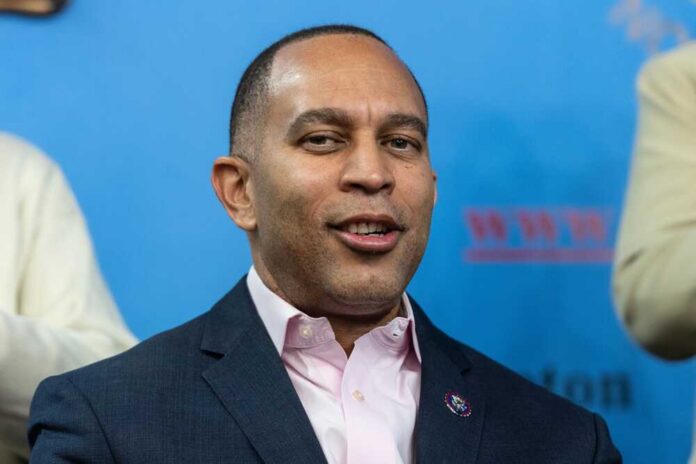
House Democrat leader Hakeem Jeffries blasted the Supreme Court as “corrupt” after one ruling, then leaned on its authority the next day—an attack-and-praise whiplash that undermines trust and invites dangerous court-packing talk.
Story Highlights
- Jeffries called the Supreme Court “corrupt” and “the Trump Court” over a Voting Rights Act case.[2][3]
- Top trial lawyer groups warned his rhetoric erodes faith in judicial independence.[1][2]
- Democrats revived pushes for major court “reforms,” including term limits and restructuring.[13]
- Public confidence in the Court is already near historic lows, heightening the stakes.[19]
Jeffries Escalates Attacks After Voting Rights Act Ruling
On April 29, 2026, House Democratic Leader Hakeem Jeffries denounced the Supreme Court’s conservative majority after a Voting Rights Act decision tied to Louisiana redistricting. He called the majority “corrupt,” labeled it the “Trump Court,” and claimed the ruling would suppress votes. He vowed to pass the John R. Lewis Voting Rights Advancement Act and floated sweeping changes to the judiciary. His remarks followed a narrative that the Court weakened protections against racial gerrymandering.[2][3]
Video remarks amplified the charge by branding the majority “illegitimate” and alleging a scheme to “rig” elections. Jeffries framed the bench as a partisan engine rather than an independent branch. Those claims spread quickly across social media and activist channels. Supporters argued the ruling over-relied on race in map drawing. Critics countered that the Constitution bars race-driven districts and that the Court enforced neutral standards. The rhetoric, not the legal details, led the coverage.[3]
Legal Community: Attacks Cross a Line and Damage the Courts
Leading professional groups in the legal field pushed back. The American College of Trial Lawyers said Jeffries crossed an important line by calling justices “corrupt.” The group warned that suggesting rulings come from corrupt motives erodes public confidence in judicial independence and the rule of law. The American Board of Trial Advocates echoed that concern, citing his “illegitimate” and “corrupt” labels as unfair attacks on the Court’s integrity.[2][10]
These rebukes matter because they come from practitioners, not politicians. Trial lawyers argue tough over outcomes every day, but they rely on stable courts. They warned that relentless delegitimization makes every close case look rigged to the losing side. That invites tit-for-tat escalation, court-packing threats, and pressure campaigns against judges. Once trust cracks, parties are tempted to ignore decisions they dislike, which harms equal justice under law.[2][10]
Reform Push Grows As Confidence Slumps
Democrats used the ruling to renew calls for structural “reforms.” Proposals include term limits, jurisdiction changes, and statutes to override recent precedents. Activists described the majority as captured by political opponents and urged rapid action in a new Congress. The push comes at a time when public views of the Supreme Court remain near historic lows, making institutional attacks more potent and more risky for national unity.[13][19]
🚨BOOM: Hakeem Jeffries just BLASTED the Supreme Court’s
reckless decision to give Trump more power over independent federal agencies.“The decision by the Supreme Court (gives Trump) more power to continue to destroy America from within.” DAMN.pic.twitter.com/YxCNzYsFVt
— The Real Axel Vasa (@RealThe36679) June 30, 2026
Polling shows about half of Americans now view the Court unfavorably, while favorable views have fallen sharply since 2020. Among Democrats, favorability is especially low. Most Americans still want justices to keep politics out of decisions. That gap between expectation and perception fuels anger on the left and suspicion on the right. It also creates an opening for extreme fixes that would weaken checks and balances for years.[19]
Why Conservatives See a Double Standard—and What Comes Next
Conservatives note a pattern: when rulings cut against left-wing goals, Democrats label the Court “illegitimate” and demand court-packing; when rulings help them, they embrace the institution. That pick-and-choose respect is corrosive. The Constitution sets the judiciary apart to apply law, not polls. If Congress can bully the Court by smearing justices and threatening structural rewrites, then no right—speech, faith, guns, or elections—stays safe from raw power.[2][13]
Healthy debate over opinions is fair. Smearing judges as “corrupt” without evidence is not. The better path is clear rules, real federalism, and honest elections that do not sort voters by race. Lawmakers should advance transparent legislation and defend due process. Voters should reject court-packing schemes that would boomerang when power flips. Respect for the Supreme Court does not mean liking every outcome. It means keeping the guardrails that protect everyone, no matter who wins the next election.[1][2][19]
Sources:
[1] Web – Make Up Your Dang Mind, Hakeem: Supreme Court Whiplash: Pack It …
[2] Web – ACTL Denounces Remarks by House Minority Leader Hakeem …
[3] Web – LEADER JEFFRIES STATEMENT ON SUPREME COURT …
[10] Web – [PDF] State v. Jeffries – Supreme Court of Ohio
[13] Web – Rep. Hakeem Jeffries condemned the Supreme Court’s Voting …
[19] Web – The Supreme Court: How Did We Get Here? And What Comes Next?