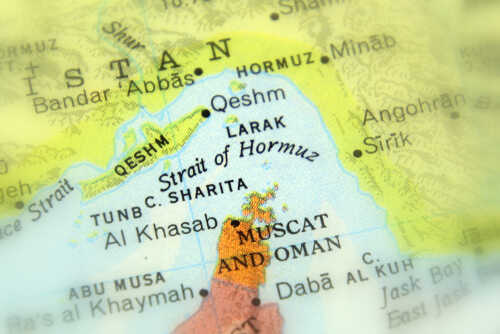
A Singapore-flagged cargo ship was hit near the Strait of Hormuz just hours after Iran warned ships to obey its routes, laying bare a dangerous test of Trump’s fragile peace deal and the freedom of global trade.
Story Snapshot
- Iran is asserting control over the Strait of Hormuz, warning ships to follow its routes or risk attack.
- The Ever Lovely was struck by an unknown projectile off Oman, but its Taiwan operator says the vessel is unharmed and sailing on.
- Two U.S. officials blame Iran’s Revolutionary Guard, while international bodies stop short of naming Iran, feeding confusion.
- Random strikes on commercial ships threaten global energy supplies and raise costs for American families.
Ship Hit Near Hormuz After Iranian Warning
The Ever Lovely, a Singapore-flagged container ship operated by Taiwan’s Evergreen Marine, reported being hit by an unknown projectile off the coast of Oman, near the Strait of Hormuz.[5] British maritime agency United Kingdom Maritime Trade Operations said the vessel was struck on its starboard side, with damage to the bridge but no injuries or pollution reported.[5] The incident came only hours after Iranian authorities warned that ships using routes not approved by Tehran would not be guaranteed safe passage through the strait.[1]
Iran’s Persian Gulf Strait Authority said that any consequences from using “unauthorized routes” would fall on the ship owner, operator, and captain, effectively trying to shift blame while threatening force.[1] Iran’s Revolutionary Guard repeated that safe passage would be possible only on routes designated by Iran, claiming the right to act against vessels that did not comply.[1] This stance challenges long-standing international maritime law, which protects transit passage through key straits used for global navigation, including Hormuz.[3]
U.S. Officials Point to Iran as Global Bodies Hesitate
Two senior U.S. officials told reporters that Iran fired on the Ever Lovely, and a security source said the ship was likely targeted by a drone, suggesting a deliberate strike instead of an accident.[1] Other outlets have similarly reported that a one-way attack drone approached the ship from the west before impact, aligning with a planned strike profile.[3] These claims match Iran’s earlier pattern, where Revolutionary Guard forces hit multiple ships and then demanded all vessels get Iranian approval before crossing Hormuz, treating an international waterway like their private toll road.[3]
Taiwan’s Evergreen Marine, however, described the weapon only as an “unknown object” and avoided publicly naming Iran as the attacker.[4] Singapore’s maritime authority called the incident “unprovoked” and a “breach of international law,” but also stopped short of directly blaming Iran.[6] The United Nations’ International Maritime Organization paused its ship escort operation through Hormuz after the attack, citing safety concerns yet not formally assigning responsibility.[1] This caution from regulators and global bodies creates a public fog, even as U.S. officials lay the blame squarely on Iran’s Revolutionary Guard.[1]
Pattern of Random Disruption and Rising Costs
Lloyd’s List Intelligence data shows at least sixteen ships have been hit in the region since late February, with flags and owners from nine different countries and no clear pattern in targets.[18] Analysts say these attacks appear calibrated to disrupt commercial shipping rather than to hit specific nations, sending the message that “nobody is really safe” in these waters.[18] During the 1980s “tanker war,” similar strikes still disrupted less than two percent of all ships in the Persian Gulf, but they drove fear, insurance costs, and political pressure sky-high.[21]
Today, Iran’s pressure on Hormuz is already squeezing global energy flows. Around a fifth of the world’s oil passes through this narrow strait, and recent conflict has driven many ships to halt or U-turn, pushing up prices and uncertainty.[20] When shipping slows, insurance costs rise, and trade routes shift, Americans back home pay more for gasoline, groceries, and basic goods. These attacks may be far away on a map, but they reach straight into the wallets of U.S. families, especially retirees and working households already tired of inflation and government overspending.[20]
Testing Trump’s Ceasefire and America’s Resolve
The strike on Ever Lovely came shortly after President Donald Trump extended a ceasefire with Iran to give Tehran time to bring a unified proposal to upcoming talks.[2] Iran has offered no clear acknowledgment of that extension, and the attack now hangs over those diplomatic efforts like a cloud.[2] By firing on a commercial vessel during a delicate pause in fighting, Iran is testing U.S. resolve and trying to enforce its own rules on a key global chokepoint, outside accepted international law.[1]
BREAKING: Iran's IRGC attacked a Singapore-flagged cargo ship in the Strait of Hormuz today – per two senior U.S. officials, per the Wall Street Journal.
The vessel: Ever Lovely, an Evergreen Marine ship that had been stuck in the Persian Gulf for more than 100 days. It was… https://t.co/ZLoyOhEywN pic.twitter.com/G4SkT5ZETU
— The Tectonic (@thetect0nic) June 25, 2026
Reports show Iran has already claimed or carried out other attacks on cargo ships in the Strait of Hormuz, including a Thai-flagged vessel, while publicly insisting that ships must seek its approval before transiting.[4] This behavior fits a broader push to control the strait and use commercial shipping as leverage against the West, even as the United States and allies work to keep the sea lane open and protect free trade.[19] Random hits on foreign ships, vague threats about “unauthorized routes,” and silence about responsibility all point to a strategy built on fear, confusion, and economic pain.
Sources:
[1] Web – Taiwan ship operator says vessel hit in Hormuz ‘unharmed’
[2] Web – Ship Struck in Hormuz as Oil Supertankers Turn Back Again
[3] YouTube – Iran attacks ship in Strait of Hormuz after Trump extends ceasefire
[4] Web – Iran Attacks Cargo Ship, Testing Trump’s Deal to Reopen Strait – WSJ
[5] Web – Taiwan’s Evergreen says ship was hit by unknown object off Oman
[6] Web – Lovin Malta – Facebook
[18] Web – Iran said it forced a US warship to turn back from the Strait of …
[19] Web – Iran attack wipes out 17% of Qatar’s LNG capacity for up to five years …
[20] YouTube – Iran attacks cargo ship in the Strait of Hormuz
[21] Web – Data shows attacks on ships in the Middle East do not follow a …