
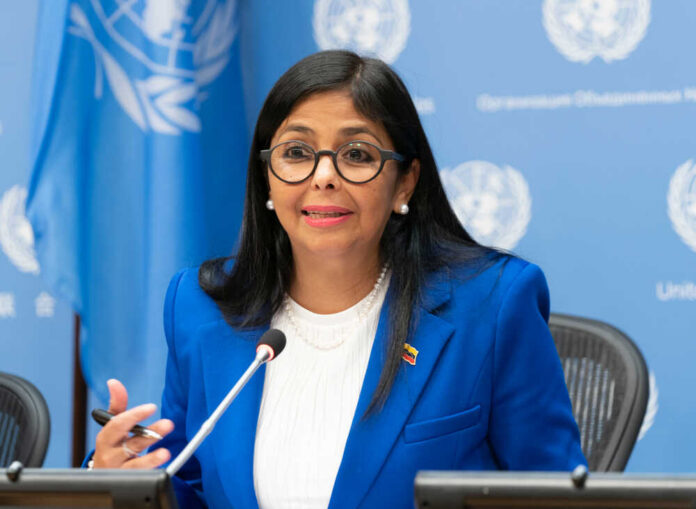
Venezuela’s acting leader Delcy Rodríguez is courting India for energy deals, testing U.S.-aligned pressure on Caracas while dangling crude to a fuel-hungry partner.
Story Highlights
- Delcy Rodríguez discussed “strategic cooperation in energy” with India’s Prime Minister Narendra Modi, signaling potential crude flows to India [1].
- Indian and Venezuelan statements point to broader cooperation, but energy—specifically renewed crude imports—was central in recent talks [2].
- Public messaging from Caracas frames the outreach as routine diplomacy, not a geopolitical pivot, leaving outcomes dependent on sanctions and operational realities [1].
- India-Venezuela ties have precedent, including high-level visits, giving both sides a platform to expand energy trade if constraints ease [4].
Rodríguez Courts India Amid Energy Realignment Signals
Venezuelan acting President Delcy Rodríguez said she addressed “strategic cooperation in energy” in a call with Indian Prime Minister Narendra Modi, underscoring oil as a focal point for possible collaboration [1]. Indian coverage emphasized that energy cooperation, including potential renewed crude imports, was at center stage in the latest engagement [2]. The overture places India—one of the world’s largest crude importers—closer to Venezuela’s petroleum sector at a time when supply diversification and price stability remain top priorities for New Delhi.
WION’s reporting framed the conversation as a step to “expand and deepen” the bilateral partnership, with energy featured prominently in the agenda [2]. That framing aligns with New Delhi’s practical approach to sourcing affordable crude from multiple suppliers, while giving Caracas a pathway to monetize output beyond traditional buyers. The public characterization, however, stops short of confirming firm volumes, timelines, or contracts, leaving the concrete impact on global trade patterns uncertain until deals are inked and shipments scheduled [2].
Claims, Counterclaims, and What the Facts Actually Show
Some commentary interprets Rodríguez’s outreach as evidence of expanding United States influence over Venezuela or a broader realignment in oil trade. The available on-record statements, by contrast, describe routine state-to-state cooperation with energy at the forefront, alongside agriculture, mining, technology, tourism, pharmaceuticals, and automotive sectors [1]. That breadth of topics is consistent with standard bilateral agenda-setting and does not alone verify a geopolitical pivot driven by Washington or a decisive reshaping of oil flows without further substantiation [1].
A prudent reading recognizes strong incentives on both sides without overpromising outcomes. India seeks reliable, competitively priced crude to curb inflationary pressures and shield consumers from supply shocks. Venezuela seeks paying customers and investment to stabilize production and revenues. Yet market outcomes depend on sanctions parameters, company compliance risk, shipping and insurance availability, and the capacity of Petróleos de Venezuela’s infrastructure—factors that can delay or dilute diplomatic intent until regulatory and operational pieces align [1].
Why This Matters to American Energy Security and Your Wallet
American families feel energy costs first at the pump and then across groceries, utilities, and goods. If India meaningfully increases crude purchases from Venezuela, global barrels could shuffle, pressuring prices and trade routes. That ripple can either ease or worsen costs here at home depending on timing and market tightness. The measured statements from both capitals suggest talks are exploratory, but energy-centered, which means Americans should watch for concrete supply contracts and shipping manifests before expecting price shifts [2].
For conservatives who value U.S. energy independence and a strong posture against authoritarian regimes, two realities can coexist. First, India will pursue affordable energy wherever it can get it. Second, the United States can blunt adversaries’ leverage by prioritizing domestic production, stable permitting, modern pipelines, and predictable policy. Expanding American capacity and refining flexibility remains the surest way to protect households from foreign maneuvers—far more reliable than betting on diplomatic mood swings in Caracas or purchasing choices in New Delhi.
The Track Record and What Comes Next
India-Venezuela contacts have precedent. In October 2024, Venezuela’s executive vice president Delcy Rodríguez visited New Delhi and met senior Indian officials, establishing a formal channel to discuss petroleum and broader ties [4]. The current outreach builds on that track record, providing a scaffold for potential crude sales if legal, financial, and logistical constraints can be cleared. Until contracts are confirmed, the most factual takeaway is that both sides are positioning for possible oil trade revival rather than announcing a completed realignment [4].
Conservatives should expect a steady drumbeat of headlines portraying each diplomatic step as a turning point. The record so far shows focused interest, not finalized flows. Watch three markers: announced supply contracts and volumes, tanker bookings and insurance coverage, and clarity on any sanctions-related permissions that traders and shipowners demand before lifting Venezuelan barrels. Those concrete indicators will reveal whether this week’s words become barrels that move markets—or remain another talking point in a crowded energy chessboard [1].
Sources:
[1] Web – Oil-rich Venezuela agrees to energy cooperation with India – FMT
[2] YouTube – Venezuela, India Step Up Energy Cooperation | WION News
[4] Web – India-Venezuela Relations – Embassy of India, Caracas, Venezuela