

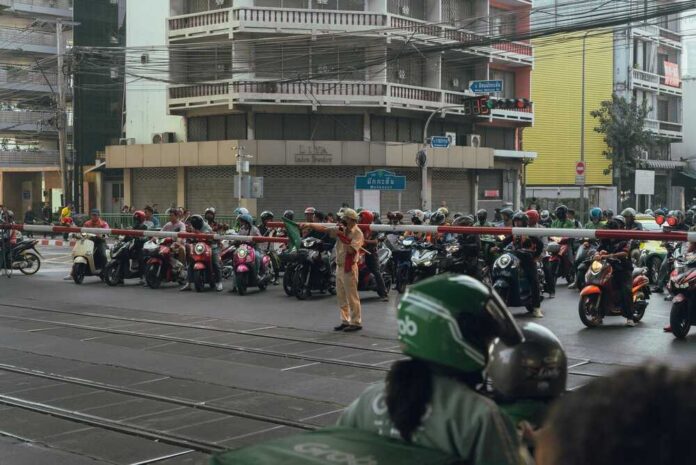
A deadly train–bus collision in Bangkok is a sobering reminder that when governments fail basic transport safety, ordinary families pay the price.
Story Snapshot
- At least eight people were killed and more than twenty injured when a freight train struck a public bus in Bangkok, Thailand.
- Early reports stress that police have sealed off the area and are still investigating, leaving key questions about responsibility unanswered.
- Circulating video clips show the impact but do not yet clarify whether infrastructure, operators, or traffic controls failed.
- The crash fits a troubling pattern of repeated train–bus disasters in Thailand, raising concerns about global transit safety standards.
What We Know About the Bangkok Train–Bus Collision
Emergency officials in Bangkok reported that at least eight people were killed and more than twenty injured after a cargo train slammed into a public bus near the Makkasan railway crossing on a busy city road.[1][2] The collision triggered a fire that engulfed the bus, forcing rescuers to battle flames while pulling victims from the wreckage.[2] The city’s Erawan Medical Center confirmed the initial casualty figures, warning that the number of injured could rise as hospitals assessed patients. This was an urban commuter setting, not a remote rural track.
Police accounts quoted in regional media say officers were alerted in mid-afternoon and arrived to find a freight train had collided with a public bus and several private vehicles, including cars and motorcycles.[2] Firefighters quickly moved in, spraying water to contain the blaze while rescue teams transported survivors to nearby hospitals.[2] Authorities have not publicly identified the victims, and there is no completed reconstruction of the sequence of events. Officials emphasized that the area remained sealed while they gathered physical evidence and documented the scene.[2]
Cause Still “Under Investigation” While Images Race Ahead
Channel News Asia reports that a video circulating online shows vehicles waiting at an intersection as a slow-moving train crosses and strikes what appears to be one of the vehicles.[1] That clip gives the world a dramatic visual but does not, by itself, answer whose rules were broken. Current coverage lacks core facts: the status of warning lights or gates at the crossing, the cargo train’s speed and braking, and whether the bus was stopped legally or trapped on the tracks.[1][2] Without those details, any confident blame narrative is premature.
Thai outlets quoting police stress that “the cause of the accident” is still being investigated and that the site has been locked down specifically to preserve evidence for later legal proceedings.[2] Reports use careful, provisional language—“initially found,” “under investigation”—which is standard after mass-casualty transport incidents when investigators have not yet reviewed event-recording data, camera footage, and witness statements.[1][2] There is no published statement from named investigators, the rail operator, the bus company, or traffic engineers explaining why the crossing failed to keep bus passengers out of harm’s way.
A Pattern of Rail–Road Disasters and Weak Infrastructure
This Bangkok crash is not a rare fluke for Thailand. In 2020, at least eighteen to twenty people were killed and dozens injured when a freight train hit a tour bus carrying passengers to a religious ceremony east of the Thai capital.[3][4] Images from those earlier scenes showed buses torn open, roofs ripped off, and debris scattered across trackside areas.[3] Safety analysts have noted that Thailand suffers some of the highest road-fatality rates in the world, with repeated tragedies at unprotected or poorly protected rail crossings.[3][4]
One earlier case involved a tour bus that collided with a cargo train as it crossed tracks, killing at least twenty people and injuring many more.[4] Another incident saw a freight train smash into a bus amid reports that many railway crossings lacked proper barriers and controls. That history matters for American readers because it illustrates what happens when governments tolerate weak infrastructure, sloppy enforcement, and politicized bureaucracies instead of insisting on clear responsibility and modern safety systems. When crossings rely on hope instead of hard engineering, families riding to work or worship are the ones sacrificed.
Why This Matters to Americans Watching from Trump’s America
American conservatives know from experience that global elites talk endlessly about climate conferences and diversity agendas while ignoring basic public safety. The Bangkok crash underscores a hard truth: when officials hide behind phrases like “under investigation” without quickly sharing facts, citizens instinctively suspect that agencies are protecting themselves rather than the public.[1][2] We have seen similar patterns after disasters at home, when bureaucrats slow-walk information, shift blame, and hope the outrage cycle burns out before accountability lands.
#Breaking :Train-Bus Collision in Bangkok
A train collided with a bus on Asok-Din Daeng Road near the Makkasan railway area, causing the vehicle to catch fire. Emergency responders are on the scene. Authorities report 8 fatalities so far. #รถไฟชนรถเมล์ pic.twitter.com/KniOA893Kw— PolicyInsights (@Policyinsts) May 16, 2026
As President Trump’s second administration pushes for secure borders, rebuilt infrastructure, and accountability from taxpayer-funded agencies, this tragedy is a cautionary example of what not to become. Americans should expect more than vague assurances after lives are lost. That means demanding transparent crash reports, data from event recorders, and clear responsibility when rail and road systems fail. If governments—here or abroad—cannot keep a simple rail crossing safe, they have no business lecturing anyone about “progress.”
Sources:
[1] Web – Freight train collides with bus in Bangkok, at least eight dead: …
[2] Web – At least eight dead after freight train hits public bus in Bangkok
[3] Web – Thailand train bus crash hi-res stock photography and images – Alamy
[4] YouTube – Passenger train derails in Thailand, killing at least 22 and …