

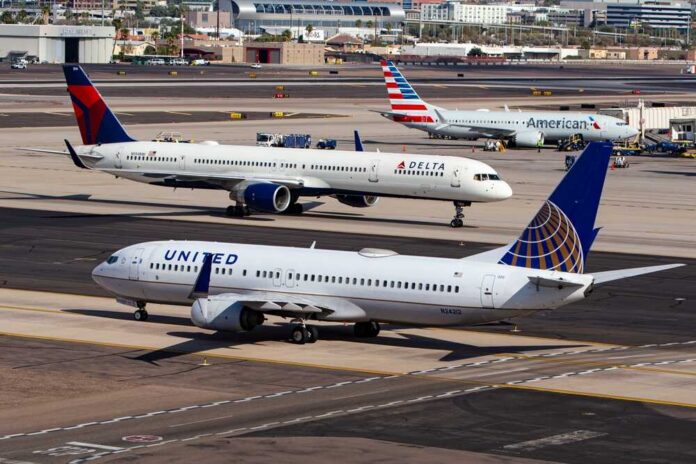
United Airlines CEO Scott Kirby’s audacious attempt to merge with American Airlines—a deal that would have created the world’s largest carrier—crumbled after American’s CEO publicly rejected the overture, exposing deep divisions over whether massive consolidation serves passengers or simply concentrates power in fewer corporate hands.
Story Snapshot
- United CEO Scott Kirby confirmed he pitched a merger to American Airlines in early 2026, enlisting Trump administration support, but American CEO Robert Isom flatly refused
- The proposed merger would have combined the two largest U.S. carriers, creating unprecedented market dominance and raising monopoly concerns at major hubs
- Kirby declared the idea “off the table for the foreseeable future” on April 27, 2026, after American publicly called the merger harmful to competition and consumers
- The rebuffed deal underscores tensions between deregulation advocates seeking global competitiveness and critics warning against corporate consolidation that could squeeze travelers
Trump Administration Involvement in Merger Pitch
Scott Kirby approached President Donald Trump and Transportation Secretary Sean Duffy in February 2026, floating the merger idea as a means to strengthen American aviation against global rivals. Duffy signaled openness to the concept, reflecting the Trump administration’s pro-business, deregulation stance that contrasts sharply with Biden-era antitrust enforcement. The administration’s early receptiveness gave Kirby political cover to pursue what would have been the most significant airline consolidation in over a decade, though no formal regulatory approval process began.
American Airlines Publicly Rejects Consolidation
American Airlines CEO Robert Isom dismissed the merger proposal as “bad for all parties” during public comments approximately four days before Kirby’s official statement. Isom’s firm rejection centered on concerns that combining United and American would harm competition and ultimately hurt consumers through reduced choices and potential fare increases. The rebuff left Kirby without a willing partner, forcing him to acknowledge that “something this big simply can’t get done” unilaterally. American’s stance prioritizes independence and competitive market dynamics over potential synergies.
Historical Context of Airline Consolidation
The U.S. airline industry underwent dramatic consolidation following the 2008 recession, with mergers like Delta-Northwest, United-Continental, and American-US Airways reducing nine major carriers to four. These deals occurred amid bankruptcy waves and aimed to create financially stable competitors capable of weathering economic downturns. However, further consolidation has faced mounting antitrust scrutiny, exemplified by the Federal Trade Commission’s 2024 block of the JetBlue-Spirit merger. Kirby’s pitch represented an attempt to restart mega-merger activity under a friendlier regulatory climate, testing whether Trump-era policies would reverse prior enforcement patterns.
Implications for Passengers and Industry Structure
A United-American merger would have created the world’s largest airline by passenger volume, wielding unprecedented control over key hubs like Chicago O’Hare and Dallas-Fort Worth. While Kirby framed the consolidation as necessary for competing globally against Middle Eastern and low-cost carriers, critics warned it would eliminate meaningful competition on countless domestic routes. The collapse preserves the current four-major-carrier structure, maintaining existing fare dynamics and service levels but potentially leaving U.S. airlines at a scale disadvantage internationally. Passengers avoided immediate disruption, though the episode highlights ongoing tensions between efficiency through consolidation and protection of competitive markets.
United’s Path Forward After Rejection
Following American’s rebuff, Kirby pivoted to emphasizing United’s standalone growth strategy, describing the airline’s current trajectory as a “winning strategy” focused on internal innovation rather than external partnerships. United now faces the challenge of achieving global competitiveness without the scale advantages a merger would have provided. The failed pursuit may push United toward international alliances or targeted acquisitions of smaller carriers instead of transformative domestic consolidation. Industry analysts note Kirby’s public confirmation reframes what could have appeared as strategic failure into a transparent acknowledgment of explored options, preserving his credibility while closing the door on near-term mega-merger ambitions.
Sources:
United Airlines drops merger pursuit with American, CEO Kirby details why – Fox Business
United CEO confirms American merger idea is off the table after rejection – AeroTime