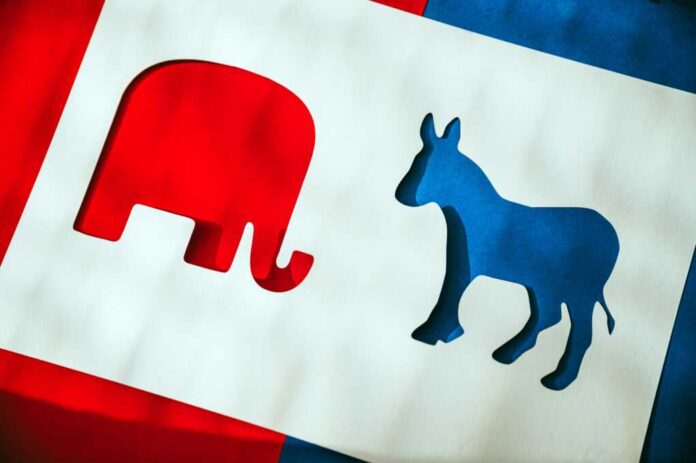
The Supreme Court just tore down one of the last big walls on campaign spending, handing Republicans and free speech advocates a major win while sending the left into a panic about money and power in politics.
Story Snapshot
- The Court struck down federal limits on political party spending coordinated with candidates, calling them a First Amendment violation.
- Republicans, led by the National Republican Senatorial Committee, argued that spending with their own candidates is political speech the government cannot cap.
- The Trump administration broke with past practice and refused to defend the old law, saying it clearly burdened core speech rights.
- Critics on the left claim the ruling will boost wealthy donors and “quid pro quo corruption,” but offer predictions, not proof.
Supreme Court Sweeps Away Party Spending Caps
In *National Republican Senatorial Committee v. Federal Election Commission*, the Supreme Court ruled 6–3 that federal limits on political party spending coordinated with candidates violate the First Amendment. The case targeted a post-Watergate rule that capped how much national and state party committees could spend in direct cooperation with federal candidates. These caps had been upheld in 2001 in the decision known as *Colorado II*, which treated coordinated party spending like a campaign contribution and allowed limits in the name of fighting corruption. The new ruling expressly walks away from that earlier logic.
Justice Brett Kavanaugh wrote that coordinated spending limits burden core political speech by parties and candidates working together to talk to voters. The Court found that Congress may still limit direct contributions, but cannot block parties from using their own funds to support their own nominees through shared ads, mailers, and voter outreach. The majority stressed that money used to spread political messages is speech, echoing earlier decisions such as *Buckley v. Valeo* and *Citizens United v. Federal Election Commission*, which held that spending to influence elections is protected expression under the First Amendment.
Trump Administration Backs Free Speech, Not Old Rules
The Trump Justice Department took an unusual stand in this case by refusing to defend the spending caps. For decades, the Department of Justice almost always argued in favor of keeping federal laws on the books, even if they raised hard questions. Here, Solicitor General D. John Sauer told the Court that the limits were a rare law that clearly violated fundamental speech rights. He wrote that the core job of a party is to promote its candidates and that it does that best when it can work closely with them, not with a bureaucratic cap hanging over every shared ad or message.
Republican challengers, including the National Republican Senatorial Committee and Vice President J.D. Vance, framed the ban on coordinated party expenditures as a direct attack on their ability to speak to voters about their ticket. They argued that when a party and candidate design messages together, that activity is at the heart of American elections, not a suspicious backdoor for corruption. The Court agreed that the old rule treated routine campaign work as if it were a shady scheme, and that this approach no longer fit with modern First Amendment doctrine and decades of cases limiting government control over campaign speech.
What Changes Now: Stronger Parties, More Direct Political Speech
This ruling gives political parties what one analysis called “the best of both worlds”: they can now coordinate directly with candidates and also raise funds without the old coordinated spending caps. That means party committees, not just outside super political action committees, will play a larger role in financing ads, voter outreach, and get-out-the-vote efforts. Strategists have long complained that strict limits pushed power toward independent groups that answered more to billionaires than to voters in a party base. By lifting the caps, the Court shifts influence back toward formal party organizations.
Existing contribution limits, earmarking rules, and disclosure laws still apply, and the majority leaned on these safeguards to answer corruption worries. Individuals are still limited in how much they can give directly to a party or candidate. Donors cannot legally earmark funds for a specific candidate in secret, and modern disclosure systems make it easier than ever for citizens and watchdogs to see who is funding whom. The Court reasoned that these tools are enough to stop real “quid pro quo” deals, where money is traded for official favors, without silencing broad political speech between parties and their nominees.
Left-Wing Alarm Over Donor Influence and “Alternative Checking Accounts”
Justice Elena Kagan’s dissent warned that the decision lets parties act as “alternative checking accounts” for campaigns, where wealthy donors can route large sums in hopes of special access or favors. She argued that the old rule helped block attempts to dodge basic contribution limits through party committees. Liberal advocacy groups like the Campaign Legal Center and the Brennan Center for Justice echoed this concern, claiming the ruling will open new paths for “dark money” and expand the reach of big donors in both major parties.
So far, however, critics mainly offer predictions, not hard data, about new corruption risks. They have not produced specific cases showing donors already using party committees to buy policy favors or personal gain since the decision. The Court’s majority noted that its job is to weigh actual laws against the Constitution, not speculative future abuses. For many conservatives, this is a welcome return to first principles: the government must prove real corruption, not just dislike for how citizens and groups choose to spend their own money to speak and organize.
Fitting a 50-Year Trend: The Court Keeps Limiting Speech Restrictions
This campaign finance ruling follows a clear pattern, stretching back to *Buckley v. Valeo* in 1976 and *McCutcheon v. Federal Election Commission* in 2014. In *Buckley*, the Court said spending to influence voters is akin to speech and cannot be broadly capped, while direct contributions can be limited to fight outright bribery. In *McCutcheon*, the Court struck down overall limits on how much one person can give in total to many candidates and committees, finding those caps did not help stop corruption but did stop lawful political participation.
Many on the left see this trend as “gutting” campaign finance laws, but for conservatives it reflects a vital truth: free people must be able to support causes and candidates they believe in without Washington deciding how loud they can be. Today’s decision on coordinated party spending keeps that logic intact. It strengthens formal parties, checks the power of unaccountable outside groups, and reminds Congress that the First Amendment does not bend simply because some activists distrust how ordinary Americans, church groups, and small businesses choose to join together and speak about their country’s future.
Sources:
feedpress.me, fec.gov, americanprogress.org, theconversation.com, brennancenter.org, youtube.com, cov.com, supremecourt.gov, facebook.com