
Just days after President Trump deployed US nuclear submarines as a warning to Moscow, Russia and China showcased their growing military alliance by simulating the destruction of an “enemy” submarine near American assets—raising the stakes for US security and global stability.
Story Snapshot
- Russian and Chinese navies held joint anti-submarine drills in the Sea of Japan immediately after US nuclear submarines were moved near Russia.
- Trump’s decisive military maneuver was a direct response to provocative statements from former Russian President Dmitry Medvedev.
- The exercises highlight unprecedented Sino-Russian military cooperation and signal defiance against US influence in the Pacific.
- Regional tensions and the risk of escalation now threaten American interests and constitutional security priorities.
Sino-Russian Joint Military Drills Follow Trump’s Nuclear Submarine Deployment
In early August 2025, Russian and Chinese naval forces conducted major joint exercises in the Sea of Japan, simulating the detection and destruction of an “enemy” submarine. This exercise came just days after President Donald Trump repositioned two US nuclear submarines near Russian waters, aiming to deter further aggression after former Russian President Dmitry Medvedev issued inflammatory threats. The drills, which concluded on August 6, underscore the rapid, high-stakes military signaling now defining the US-Russia-China relationship.
The exercise involved advanced anti-submarine warfare tactics, live-fire training, and coordinated maneuvers between the Russian Navy and China’s People’s Liberation Army Navy. According to Chinese and Russian defense ministries, the drills included the procedural ‘mock-destruction’ of an ‘enemy’ submarine—a maneuver observers say serves as a symbolic deterrent to Washington. Notably, these events unfolded just before Trump’s ceasefire ultimatum to Russia over the ongoing Ukraine conflict, further heightening global concern about brinkmanship and the potential for military miscalculation.
Historical Context: Escalating Military Alliances Challenge US Leadership
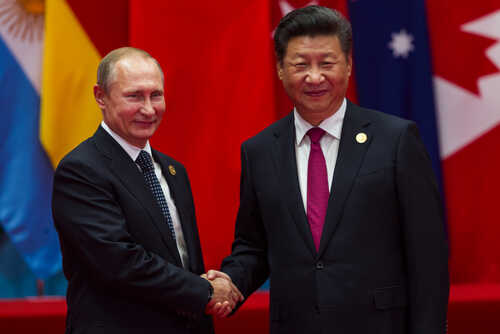
Sino-Russian military cooperation has increased dramatically since 2003, with the two powers conducting regular joint drills and steadily expanding their operational complexity. The Sea of Japan, a flashpoint region bordered by Russia, Japan, and close to China, has become a theater for this show of force. Russia’s pivot to Asia—driven by Western sanctions and diplomatic isolation—has aligned with China’s ambition to counter US naval dominance in the Pacific. These joint exercises, especially following direct US military maneuvers, underscore a deepening strategic partnership that directly challenges America’s security and influence in the region.
The timing and location of these drills are no coincidence. Both Moscow and Beijing aim to project unity and deter US intervention, especially amid ongoing disputes over Ukraine and growing US alliances in the Indo-Pacific. For American conservatives concerned about globalism and threats to national sovereignty, this alignment between two authoritarian regimes raises alarms about the erosion of US-led order and the need for robust deterrence rooted in constitutional authority and traditional values.
Key Stakeholders and Strategic Interests
The primary actors in this unfolding story are the Russian Ministry of Defense, China’s People’s Liberation Army Navy, the US government under President Trump, and high-profile figures like Dmitry Medvedev. Trump’s administration has emphasized deterrence and rapid response, while Russia and China seek to demonstrate military prowess and bilateral resolve. The White House’s decision to reposition nuclear submarines was intended to reassure US allies and warn adversaries, but it also triggered a swift and coordinated reaction from Moscow and Beijing.
Diplomatic efforts continue, with US envoy Steve Witkoff preparing to engage Russian officials ahead of Trump’s ceasefire deadline. However, the shadow of these naval maneuvers looms large, complicating diplomatic outreach and raising the risk of accidental escalation or miscalculation—a scenario that could threaten American lives and constitutional freedoms.
Implications for US Security and Conservative Values
Analysts, including Jacob Stokes of the Center for a New American Security, warn that these evolving military dynamics may elevate the risk of miscalculation and heighten alert levels near U.S. allies. Long-term, the United States risks seeing its strategic dominance in the Pacific eroded by sustained Sino-Russian cooperation. For conservatives, this signals a need to double down on strong defense, vigilance against globalist erosions of sovereignty, and policies that prioritize the Constitution and national security above appeasement or naïve engagement. The risk of miscalculation, especially with nuclear assets in play, cannot be understated, and the pressure on the current administration to uphold American values and deterrence is immense.
Russia, China practice destroying 'enemy' submarine in naval drill after Trump moves US nuclear assets
Source: Fox News https://t.co/L29F3BkhBB— Heather Williams Harrell (@heatherinky) August 6, 2025
Regional allies like Japan and South Korea are unsettled, while global markets remain sensitive to instability. Defense industries may see increased demand, but at the cost of heightened tension and the specter of a new arms race. The events of August 2025 serve as a stark reminder that America’s adversaries are increasingly coordinated, and that preserving the nation’s security and values requires unwavering resolve and constitutional clarity.
Sources:
RFE/RL: China, Russia End Five-Day Naval Exercises In Sea Of Japan
Fox News: Russia, China practice destroying ‘enemy’ submarine after Trump moves US nuclear assets
Chinese MOD: Chinese, Russian naval taskforces conclude maritime drill of Exercise Joint Sea 2025