

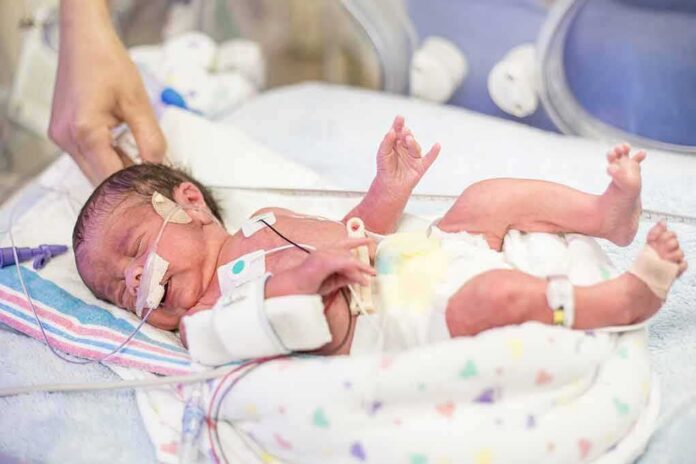
A handheld light scan spotted early signs of a deadly newborn bowel disease without exposing fragile preemies to radiation.
Story Highlights
- Researchers tested a light-based scanner that flagged necrotizing enterocolitis in premature infants.
- The pilot study reported no harm and clear signal changes during active disease.
- Today’s standard still relies on repeated abdominal X-rays in the nursery.
- Earlier, noninvasive detection could help doctors act sooner and spare babies from surgery.
Researchers Report Safe, First-in-Human Neonatal Results
Researchers ran a first-in-human pilot of broadband optical spectroscopy in two major neonatal intensive care units. The team enrolled 96 premature infants over three years and took thousands of bedside readings with a handheld probe. The device shines harmless light through the skin and reads what reflects back from the bowel. The study reported no harm and no disruption of care. Readings taken during active disease showed clear differences from routine scans.
The disease in focus is necrotizing enterocolitis. It strikes premature infants and can destroy parts of the intestine. Doctors often race the clock to catch it early. The optical approach aims to spot changes in bowel tissue before classic signs appear on images. Earlier work developed signal-processing methods to pull out the most useful features from these light spectra in infants, showing promising accuracy that guided this human pilot.
Why This Matters for Parents, Doctors, and Taxpayers
Hospitals have leaned on abdominal X-rays for decades because they are familiar, fast, and available. But plain films can be vague early on, which forces repeat scans while a baby worsens. Reviews show that radiography remains the standard today due to workflow and access, even as clinicians seek tools that point to trouble sooner. A safe, bedside light scan could reduce radiation, speed decisions, and focus scarce neonatal resources where they matter most.
Ultrasound can add detail on bowel motion, wall thickness, and blood flow, and many centers now blend it with X-rays. Yet even with ultrasound, teams still cycle images as infants change hour by hour. That repeat cycle strains families, nurses, and budgets. A noninvasive spectral scan that flags risk at the cot could guide when to escalate care, order targeted imaging, or start surgery consults, while sparing needless repeats for low-risk infants.
How the Light Scan Works and What Comes Next
The handheld probe sends a broad band of light into the abdomen and measures reflected wavelengths. Diseased bowel absorbs and scatters light differently than healthy tissue. The system looks for those spectral fingerprints at the bedside in seconds. In animal work, this approach separated sick from healthy bowel with high accuracy, which set the stage for infant studies and the new pilot findings in the nursery.
Researchers and neonatal teams now face the next step: larger trials that test the tool in everyday use, across more hospitals, nurses, and brands of equipment. The pilot shows feasibility and safety in fragile infants and documents signal shifts during real disease events. Broader studies can confirm how early the signal rises, how it pairs with ultrasound or labs, and how it changes care plans and outcomes. Until then, X-rays and ultrasound remain the clinical anchors.
A Practical Path That Respects Families and First Principles
Parents want care that is fast, safe, and wise with risk. This technology checks those boxes by avoiding radiation and sliding into bedside routines. It also respects the idea that simpler, less invasive care is often better. That aligns with common-sense medicine and good stewardship of public dollars. If larger studies confirm the gains, hospitals could use the scanner to cut repeat imaging, shorten stays, and direct attention to the sickest babies first.
Medical innovation does not have to mean bigger bills and more red tape. It can mean smarter tools in the right hands. President Trump’s administration has pressed agencies to clear paths for life-saving devices while guarding safety. Hospitals adopting proven, noninvasive tech can lift outcomes without waste. For families watching a tiny child fight a fast-moving disease, a quick light scan that helps doctors act sooner is not hype. It is hope backed by real data in the nursery.
Sources:
sciencenews.org, pubmed.ncbi.nlm.nih.gov, luriechildrens.org, podcasts.apple.com, sciaps.com