
Rapid gunfire rattled the White House perimeter as an armed suspect reportedly charged a security checkpoint, injuring a Secret Service agent and forcing an emergency lockdown while cameras rolled.
Story Snapshot
- Shots near the White House triggered a swift lockdown and a heavy law-enforcement response [1].
- Officials say the suspect charged a security checkpoint while armed with multiple weapons and was subdued [3].
- Acting Attorney General Todd Blanche said investigators believe Trump administration members were the target [3].
- A Secret Service agent was injured; investigators searched the suspect’s California residence [3].
What Happened Around the White House Perimeter
Multiple outlets reported gunfire near the White House complex and Washington Monument area, prompting an immediate lockdown and shelter-in-place orders for press and staff on Saturday evening [1][3]. Reporters described rapid shots and a significant security posture as United States Secret Service agents moved to secure checkpoints and relocate protected personnel [1][3]. Live broadcasts captured the chaos as the scene shifted into a federal security incident. Initial tallies of shots varied across outlets, reflecting normal confusion in breaking events [1][3].
Federal updates during the evening stated a suspect opened fire and allegedly engaged near a checkpoint before being subdued by United States Secret Service agents [3]. ABC’s summary said the individual “charged a security checkpoint” while armed with multiple weapons, reinforcing that this was more than a routine disturbance [3]. The reported injury to a United States Secret Service agent underscored the severity of the encounter and justified the robust response and perimeter lockdown [3]. These core facts remained consistent despite differing descriptions of precise location [1][3].
Emerging Motive, Injury Report, and Active Investigation
Acting Attorney General Todd Blanche said investigators believe the suspected gunman targeted members of the Trump administration, a statement that elevates the incident from random gunfire to an apparent attack on public officials [3]. Authorities also executed search warrants on the suspect’s California residence, indicating a broader investigative effort beyond the scene [3]. CBS reporting noted a United States Secret Service agent suffered injury during the encounter, and the suspect was hospitalized, aligning with the serious-threat framing communicated by law enforcement and the president [3].
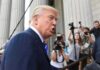
President Trump publicly condemned the attacker as a threat to the Constitution and praised the fast action of agents who halted the charge at a security checkpoint [3]. Those comments matched federal statements describing an armed assault at the perimeter, not a false alarm or accidental discharge [3]. The lockdowns reported by multiple outlets, along with the press pool’s rapid sheltering, are consistent with established protective protocols when credible danger emerges near the Executive Mansion [1][3]. The combination of injury, weapon reports, and searches suggests investigators are treating the incident as an attempted attack pending fuller evidence [3].
What We Know, What We Don’t, and Why It Matters
Reporters and officials differed on exact locations—ranging from the Washington Monument area to the White House North Lawn vicinity—and on the number of shots, a common pattern in fast-moving security events [1][3]. The available record does not include a criminal complaint, affidavit, or probable-cause statement that would lay out motive, sequence, and weapon specifics in sworn detail [3]. Without those documents, claims about premeditation or a concrete target list remain official assertions, not yet supported by publicly released evidence [3].
🇺🇸 #US: Serious gunfire near the White House as ABC correspondent Selina Wang was preparing to deliver a live report from the North Lawn.
Early reports indicate that up to 20 shots may have been fired within a short period of time. Journalists and media crews were reportedly… pic.twitter.com/YdY5LCQbtb
— POPULAR FRONT (@PopularFront_) May 23, 2026
Conservative readers should focus on the hard facts already on record: an armed man reportedly charged a checkpoint, a United States Secret Service agent was injured, the White House locked down, and investigators believe Trump administration officials were the intended targets [1][3]. Those points justify vigilance, strong protective operations, and thorough prosecution if evidence confirms intent. To close the evidentiary gap, the public needs the charging documents, surveillance footage, radio logs, and ballistics that can confirm shot counts, direction of fire, and the suspect’s actions before the first round [3].
Accountability, Transparency, and Security Priorities
Law enforcement owes the country a detailed, document-backed timeline once it will not compromise security or prosecution. Releasing incident reports, camera footage, and forensic analyses can validate the government’s narrative and deter bad-faith spin on either side [3]. If investigators recover communications indicating the suspect hunted officials, then the public case for harsh penalties and improved perimeter hardening becomes even stronger. If evidence shows a less organized attack, lessons still apply for response speed, checkpoint posture, and public alerting protocols [3].
Sources:
[1] Web – White House briefly locked down after gunfire near …
[3] Web – White House Correspondents’ Dinner shooting suspect …