
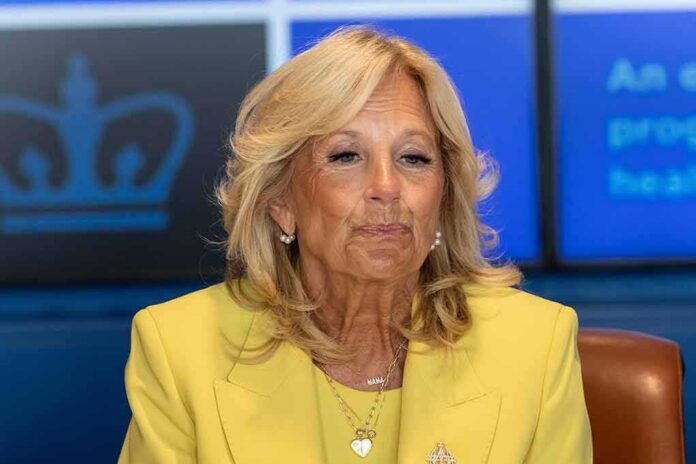
Jill Biden’s own words reopened the 2024 debate fiasco, admitting she feared a stroke and even answered “Who knows?” when asked if Joe’s drink was laced.
Story Highlights
- Jill Biden said she thought Joe Biden was having a stroke during the 2024 debate.
- She later entertained a lacing question with “Who knows?” while stressing uncertainty.
- Doctors examined Biden right after the debate and told her he was fine.
- Biden later called it a “bad night,” tied to illness and fatigue, not a serious condition.
Jill Biden’s Alarming Admission About The Debate Night
Jill Biden said she watched the June 2024 debate and thought Joe Biden was having a stroke. She told interviewers the moment frightened her because she had never seen him like that before or since. Her account refreshed public attention to a performance that shook voters and helped end his campaign. The Associated Press, the British Broadcasting Corporation, and others reported her remarks, which match video clips now in wide circulation.
Her description fits what millions saw: a hoarse voice, lost trains of thought, and answers that trailed off. The former first lady also said doctors were around them at all times. She said they checked him after the event and told her he was fine. That immediate check matters because it set a baseline for later claims and rumors. National Public Radio summarized her account of that post-debate exam.
The “Who Knows?” Moment And What It Does And Does Not Prove
In a later exchange, Jill Biden did not rule out tampering when asked if someone could have laced Joe Biden’s drink. She replied, “Who knows? Who knows, right?” Her answer signaled uncertainty, not proof. People Magazine’s summary captured the full picture: she said there was nothing definitive to point to, and that doctors told her Joe was fine that night. Those facts make the lacing idea an open question, not an established cause.
Claims need evidence, and official medical notes did not back the more dire theories. Joe Biden’s physician later wrote that a very detailed neurologic exam found no signs of stroke or major neurologic disease. The White House at the time blamed a head cold, jet lag, and poor prep. That medical letter has been widely cited, and it remains the strongest documentary record from his team about that week.
What Joe Biden Said Later About The Bad Night
Joe Biden later called the performance a bad episode tied to illness and exhaustion. He said he felt terrible, was tired, and did not prepare the way he should have. That message lined up with the physician’s assessment and the staff explanation. It did not answer every viewer question, but it gave a clear alternative to talk of a stroke or drugging. Cable reports archived those statements for the record.
Jill Biden also said no one had come to her before with concerns that matched what viewers saw that night. She framed the debate as an outlier in his behavior, not a pattern. That is important because it narrows the field of likely causes to that specific day’s condition and choices. It also supports her insistence that she had never seen Joe like that before or after the event.
Why This Still Matters For Voters Focused On Honesty And Competence
Conservative readers remember the spin in 2024: excuses, shifting stories, and pressure to “move on.” Jill Biden’s new remarks cut through some of that fog. She confirms the shock many Americans felt, and she concedes uncertainty on the cause. At the same time, the only documented medical checks cited by their camp reported no stroke and no disorder. Those two truths can live together: a bad night looked alarming, and proof of a darker cause never landed in public.
Jill Biden says Joe Biden’s drink may have been laced before his CNN debate with Trump adding only Who knows right Who knows as questions over his disastrous performance take another bizarre turn#NYI pic.twitter.com/l1q99qUwLp
— NewYork-Insight (@NewYork_Insight) August 21, 2026
For citizens who value clear answers, two standards still apply. First, do not accept lacing or medical-crisis claims without evidence. Second, do not accept tidy talking points that deny what the cameras showed. Jill Biden’s words make both points. They validate the public’s concern while reminding us that facts come from records, not hunches. That is how we defend common sense, demand transparency, and keep power honest—no matter who sits in the chair.
Sources:
twitchy.com, nbcnews.com, npr.org, apnews.com