
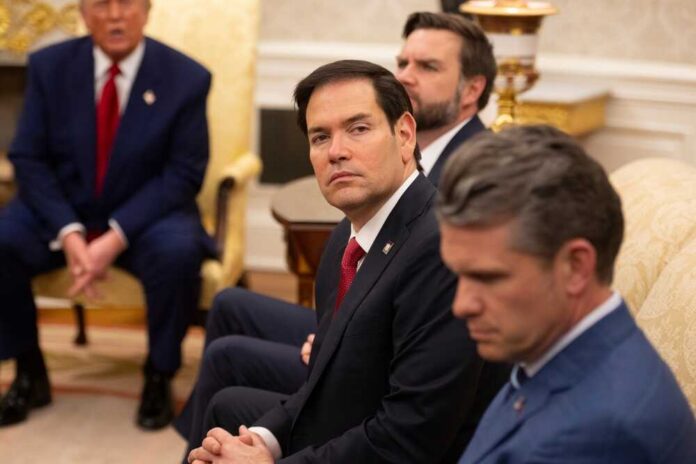
Rubio says “progress” is real and hints President Trump could move next on Iran, while critics and allies spar over what any deal must fix to keep America safe.
Story Snapshot
- Sen. Marco Rubio signals additional White House announcements could follow reported progress on an Iran framework.
- The Trump team’s stated goal since 2018 has been zero path to a nuclear weapon and tougher pressure on Tehran’s terror finance and missiles [1].
- Mike Pompeo’s on-record critiques focus on ballistic missiles, proxy forces, and enrichment gaps that plagued the old deal [3].
- Analysts and allies long flagged the prior deal’s weak political support and regional buy-in, complicating any revival effort [2][5].
Rubio Teases Next Steps As Iran Talks Reportedly Show Movement
Sen. Marco Rubio said he expects President Donald Trump to make further announcements after “progress” on an Iran arrangement, signaling the administration could outline next steps once internal reviews and allied consultations conclude. Rubio’s comments arrive as the White House balances deterrence with diplomacy. The core test remains unchanged: lock Iran out of a nuclear weapon while constraining terror financing and missile proliferation. That standard has guided Trump-era Iran policy since its 2018 reset away from the prior agreement [1].
Rubio’s nod to progress raises practical questions conservative voters care about: What is materially new, how will it be enforced, and who will verify outcomes? The last decade proved that paper promises without teeth invite brinkmanship, not peace. Any announcement must show clear triggers, snapback consequences, and unambiguous inspection access. Without those, Washington risks repeating a cycle of temporary pauses while Tehran advances capabilities under cover of diplomatic ambiguity [1].
Trump’s Post-JCPOA Doctrine: No Path To A Bomb, Real Costs For Bad Behavior
The administration’s documented approach since 2018 set a bright line: Iran gets no path to a nuclear weapon, now or ever. Then–Secretary of State Mike Pompeo publicly explained that sanctions were restored and staged on a timeline to rebuild leverage. The stated aims were concrete—cut terror finance, counter regional destabilization, and address missile proliferation—anchoring policy to measurable outcomes rather than rhetoric. Those pillars remain the benchmark for any updated framework announced in 2026 [1].
Policy analysts and regional voices long warned that the prior deal rested on shaky political ground and lacked durable regional buy-in. Institut Montaigne highlighted that it was rebuked by Republicans and only timidly supported by Democrats, a structural weakness that made the arrangement vulnerable to shifts in Washington and skepticism in Jerusalem and Gulf capitals. That deficit matters today: without allied alignment and home-front consensus, enforcement frays and Iran exploits seams among partners [2][5].
Pompeo’s Specific Critiques Define The “Must-Fix” List
Mike Pompeo’s public remarks underscored three gaps conservatives have flagged for years: ballistic missiles, proxy warfare, and enrichment constraints. He stated there was no overlap between Iran’s willingness to concede on those issues and what the United States required, a diagnosis that clarified why maximum pressure replaced the earlier approach. Any 2026 arrangement must close those gaps with text, timelines, and inspection mechanics, not aspirational communiqués that evaporate under stress [3].
European pushback to United States sanctions during the earlier period revealed another enforcement challenge. The European Union moved to blunt Washington’s measures, exposing fractures that Tehran could exploit to keep revenue flowing. That episode demonstrated that even strong American sanctions struggle if partners undercut implementation. A credible deal now must anticipate those dynamics with automatic penalties and coordinated enforcement tools that cannot be unraveled by side channels or political turnover abroad [4].
Conservative Bottom Line: Verification, Enforcement, And Constitutional Clarity
Conservatives measure national-security deals by three yardsticks: verifiable limits, automatic enforcement, and constitutional legitimacy. The 2018 State Department framing promised severe costs for Iranian violations and insisted on never repeating past mistakes. That means any new announcement should present plain-language thresholds, on-demand inspector access, and guaranteed economic consequences for noncompliance. Anything less risks green-lighting incremental cheating while Americans absorb higher energy prices and a more dangerous Middle East [1].
The White House has lashed out at former Secretary of State Mike Pompeo for criticizing the Iran deal negotiations, with Communications Director Stephen Cheung telling him to 'shut his stupid mouth'. This public rebuke highlights the ongoing political tensions within the…
— Tegu breaking news. (@tegufy_news) May 24, 2026
Rubio’s expectation of further White House detail is welcome, but the burden of proof is on the text and the tools behind it. Conservatives will back a framework that demonstrably blocks a bomb, starves terror networks, and reins in missiles—backed by united allies and airtight snapbacks. The record shows why these elements matter and where the old deal fell short. The Trump administration’s next step should translate those lessons into enforceable reality, not recycled promises that leave America and our allies exposed [1][2][3][4][5].
Sources:
[1] Web – After the Deal: A New Iran Strategy – United States Department of …
[2] Web – Iran: The Case For a Grand Bargain | Institut Montaigne
[3] YouTube – The President has set some red lines.” – Mike Pompeo
[4] Web – EU Moves to Block U.S. Iran Sanctions – JSTOR
[5] Web – “Maximum Pressure:” The Trump Administration and Iran – H-Diplo