

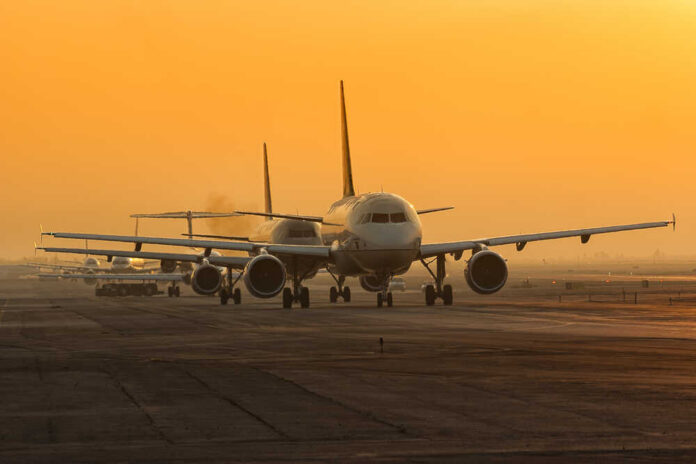
The Iran war that Trump’s administration couldn’t avoid is now grounding flights across the globe, sticking American travelers with skyrocketing ticket prices and canceled summer vacations while jet fuel prices have nearly doubled to $195 per barrel.
Story Snapshot
- Major airlines including United, Ryanair, and Lufthansa are slashing flights by 5-20% due to war-induced jet fuel shortages and prices surging nearly 100% since late February 2026
- The closure of the Strait of Hormuz by Iran has trapped 20-30% of global oil supplies, creating specialized jet fuel shortages that hit harder than regular gasoline
- United Airlines alone faces an $11 billion additional fuel cost burden, forcing carriers to cancel routes and hike baggage fees while travelers face refund chaos
- Europe and Asia are experiencing the worst shortages first, with Italian airports already rationing fuel and predictions of 40 grounded Lufthansa aircraft by summer
War’s Economic Fallout Hits Travelers Hard
The Trump administration’s involvement in the US-Israeli war on Iran, which escalated in late February 2026, has triggered a cascade of flight cancellations that directly contradicts the President’s 2024 campaign promise to keep America out of new conflicts. Iran’s effective closure of the Strait of Hormuz—a critical chokepoint handling up to 30% of global oil transit—has trapped Middle Eastern oil supplies and sent jet fuel prices rocketing from roughly $100 per barrel to $195 in just over a month. This represents the kind of foreign entanglement and economic pain that frustrated MAGA voters specifically rejected when they supported Trump’s “America First” platform.
Airlines Slash Routes as Fuel Costs Explode
United Airlines CEO Scott Kirby announced tactical pruning of unprofitable routes for the next two quarters, with the carrier facing a staggering $11 billion in extra fuel costs—more than double its best annual profit of $5 billion. Air New Zealand is cutting 1,100 flights representing 5% of its schedule starting in May, while Vietnam Airlines has suspended 10-20% of routes effective April 1. Ryanair CEO Michael O’Leary warned Sky News that suppliers are providing inadequate notice about fuel availability, forcing potential 5-10% summer flight reductions across Europe’s largest budget carrier during peak travel season.
Specialized Fuel Infrastructure Amplifies Crisis
Jet fuel shortages are hitting harder than gasoline because of specialized storage and refining infrastructure that cannot be easily substituted, according to energy analysts at Sparta Commodities. Iranian strikes targeted Kuwaiti refineries in early March, compounding supply disruptions as the International Energy Agency reports April oil losses doubled those from March. The Argus Index tracking jet fuel shows US prices surged 95% while Asia and Europe face even steeper increases. Italian airports imposed refueling restrictions in early April through suppliers like Air BP Italia, a concrete sign that rationing has already begun in import-dependent regions that lack domestic oil production.
Scandinavian Airlines announced 1,000 flight cancellations while Lufthansa faces the potential grounding of 40 aircraft if shortages persist into May and June as the IEA predicts. Smaller carriers are suffering disproportionately—UK regional airline Skybus canceled all flights on one route effective April 3, citing uneconomic conditions amid fuel uncertainty, despite receiving government subsidies. Aurigny also slashed its schedule while JetBlue responded by hiking luggage fees to offset costs. The cascading cancellations are leaving millions of travelers scrambling for alternatives as airlines consolidate remaining flights to off-peak times, maximizing load factors while minimizing fuel waste on half-empty planes.
Energy Security Concerns Mount for US Interests
IEA Executive Director Fatih Birol warned that European shortages are imminent as April’s supply disruptions dwarf March levels, with the UK identified by Argus Media as the most vulnerable Western nation due to its heavy reliance on imported refined products. While the US has seen delays tied to trucking and pipeline capacity limits rather than outright shortages, the tourism-dependent economies like Nevada’s gaming industry are already threatened by reduced air service. This war represents exactly the kind of globalist entanglement and energy vulnerability that conservative voters oppose—American families paying higher prices and losing travel options because of Middle Eastern conflicts that drain resources without clear national security benefits.
The administration now owns this crisis as jet fuel prices remain double last year’s levels according to IATA data, with no clear end in sight as long as the Strait of Hormuz remains effectively closed. Airlines are warning passengers to book immediately despite uncertainty, while industry experts debate whether the situation will stabilize or deteriorate into systemic European aviation collapse reminiscent of COVID-19 disruptions but driven by geopolitical decisions rather than public health mandates. For MAGA supporters who voted against endless regime change wars and energy dependence on unstable regions, this represents a broken promise with tangible consequences hitting their wallets and summer vacation plans.
Sources:
Strait of Hormuz closure sparks fuel rationing and oil crisis – Time
Airlines warn flight cuts to start in six weeks amid fuel shortages – NL Times
Airline cancels all flights for disturbing reason – TheStreet
Airline jet fuel shortage running dry, warning issued – Simple Flying