

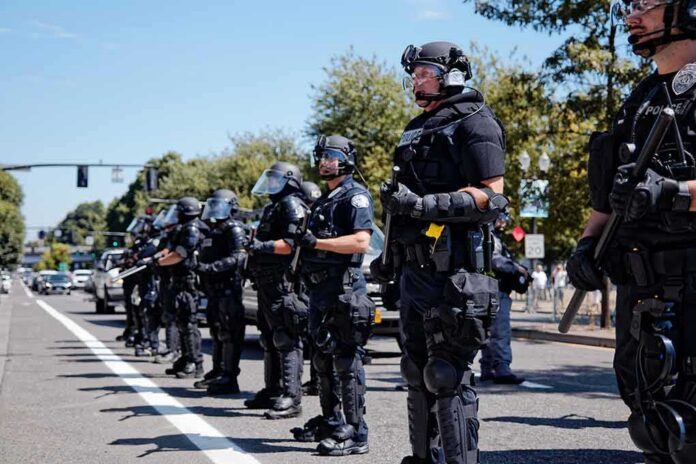
A federal appeals court just restored federal officers’ ability to use tear gas against violent agitators at Portland’s immigration facility, rejecting courtroom rules that tied agents’ hands.
Story Highlights
- The Ninth Circuit vacated two injunctions that limited federal officers’ use of tear gas and other tools in Portland.
- Judges said plaintiffs failed to show a constitutional right to be free from incidental exposure near the facility.
- The majority warned that the prior orders threatened officers with contempt for accidental impacts from crowd-control devices.
- A dissenting judge would have kept a narrow limit on targeting with projectiles at vital areas.
Ninth Circuit Reverses Portland Restrictions
The United States Court of Appeals for the Ninth Circuit ruled 2-1 to lift lower-court limits on federal officers guarding the U.S. Immigration and Customs Enforcement facility in Portland. The panel vacated injunctions that had curbed use of tear gas, pepper balls, and related crowd-control tools during unrest outside the site. The court said the challengers did not show a clear constitutional right to avoid incidental exposure to chemical agents when officers respond to unlawful activity at the facility.
Judge Kenneth K. Lee wrote the main opinion. The ruling emphasized that federal courts should not micromanage officers’ split-second decisions during volatile crowd events. The panel noted that the lower-court orders created real operational risks, including the threat that an officer could face contempt for an unintentional strike by a less-lethal round, which burdens legitimate enforcement. The decision allows federal officers to use nonlethal force when needed to stop imminent lawlessness and protect federal property.
What The Decision Does—and Does Not—Say
The ruling does not grant a blank check. Officers must still follow the Constitution and use force that is reasonable for the threat. The court rejected the idea of a free-standing right for neighbors to avoid any exposure when federal officers address violent conduct at the scene. But the panel did not endorse force against peaceful bystanders. The standard remains clear: officers get leeway when threats are real and immediate, not when crowds are calm and lawful.
The panel addressed claims raised by protesters, residents, and local officials. The court concluded the evidence did not justify broad, ongoing court control of federal tactics at the facility. The judges pointed to the demanding test for injunctions and held the plaintiffs did not meet it. The opinion stressed the public interest in protecting federal workers and property, and in allowing officers to respond quickly to danger without fear of contempt for honest mistakes.
The Dissent and Local Objections
Judge Ana de Alba dissented in part. She would have kept a narrow protection that barred firing projectiles at a person’s head, neck, or torso unless deadly force was lawful. She also pointed to one tear-gas use more than a block away from the facility, raising concern about off-site deployments near homes. Oregon’s attorney general had urged limits, arguing chemical agents and projectiles can endanger peaceful protesters and raise tensions.
City officials and some residents argued federal actions filled nearby apartments with irritants and harmed peaceful civic activity. The court acknowledged these concerns as allegations but found they did not justify sweeping, ongoing restraints on federal officers. The majority said plaintiffs did not show a likely constitutional violation or meet the strict standard for a long-running injunction. Disputes over specific incidents can still proceed on the facts, but broad prior restraints are not warranted now.
Why It Matters for Law and Order
This ruling affirms that courts cannot handcuff officers who must control violent crowds and protect federal sites. The decision restores discretion to trained personnel at the scene and rejects novel “created” rights that would block lawful crowd-control responses. For communities tired of chaos, arson threats, and vandalism near federal buildings, the message is clear: the Constitution protects speech, not rioting. Federal officers may act when agitators cross the line into imminent lawlessness.
What Comes Next in Portland and Beyond
The case returns to the lower courts without the broad restrictions. Plaintiffs can still press claims tied to specific uses of force, but they must meet settled legal standards. Federal agencies will continue to apply use-of-force rules and training for less-lethal tools. The Trump administration’s charge is to secure federal property while respecting rights. The court’s decision helps officers do their job and signals that public safety, not politics, must guide responses to violent unrest.
Sources:
opb.org, courthousenews.com, oregonlive.com, washingtontimes.com, koin.com, klcc.org, tucsonsentinel.com, case-law.vlex.com, globalfreedomofexpression.columbia.edu