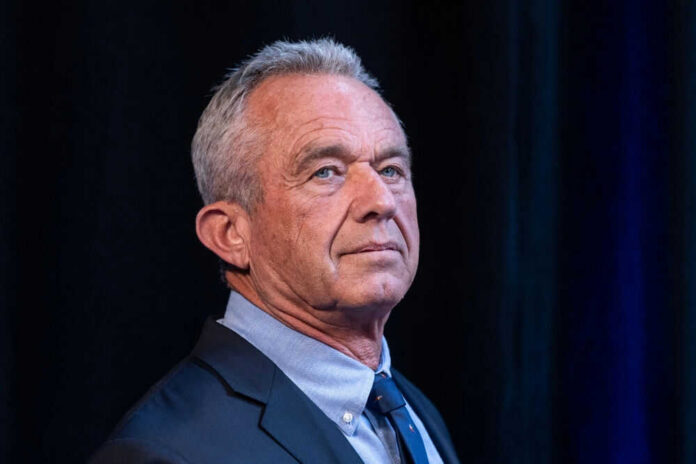
RFK Jr.’s “Make America Healthy Again” push is winning applause at CPAC—yet the quiet fight over vaccine policy and federal health power is raising alarms among conservatives who don’t want a new bureaucracy replacing Big Pharma with Big Government.
Quick Take
- HHS Secretary Robert F. Kennedy Jr. received a rousing welcome from the MAGA base at CPAC USA 2026 in Grapevine, Texas.
- Kennedy highlighted first-year actions on food dyes, dietary guidance, drug pricing, and nutrition education, while steering away from detailed vaccine talk.
- Experts and analysts are split: some initiatives could expand access and address chronic disease, while others risk weakening trust in public health institutions.
- A delayed Dietary Guidelines rollout and speculation about saturated fat rules are shaping the next major policy flashpoint.
CPAC’s Warm Reception Signals MAHA’s Staying Power
Robert F. Kennedy Jr. took the CPAC USA 2026 stage as HHS secretary with an unusually friendly reception from a crowd that once viewed him as a political outsider. The conference ran March 25–28 in Grapevine, Texas, with Kennedy appearing Saturday, March 27. His remarks emphasized first-year deliverables and framed MAHA as a populist, middle-class project aligned with the Trump coalition—even as the White House manages messaging around the most controversial parts of his portfolio.
Kennedy also used the CPAC spotlight to argue his political realignment fits his family’s legacy, saying his late father and uncle would understand his choices on major national questions. That framing matters because the base is strained on multiple fronts in 2026—war abroad, high costs at home, and distrust of institutions. MAHA’s pitch is that health policy can be reset without the progressive social engineering conservatives reject, but the governing details will decide whether that promise holds.
What Kennedy Claims as Year-One Wins—and What They Mean
Kennedy and administration-aligned sources point to concrete moves: eliminating petroleum-based food dyes, pursuing changes to the Dietary Guidelines with an “eat real food” message, pressuring drug prices down through negotiation and international leverage, and pushing medical schools to treat nutrition as foundational. HHS also signaled steps to close the GRAS loophole that can allow chemicals into foods with limited oversight, and it promised more comprehensive baby formula information by the end of March 2026.
For conservatives who are tired of bloated systems that never fix root problems, the most persuasive elements are the ones that look like common-sense consumer protection and market accountability rather than lifestyle policing. Food reformulation and clearer ingredient rules can put parents back in the driver’s seat if implemented transparently. Drug-price efforts can help families and seniors if savings reach patients without creating new mandates or rationing. The open question is how much of this is durable policy versus temporary leverage.
Chronic Disease Numbers Fuel the Case, but Results Are Harder to Prove
The administration’s MAHA argument leans on grim baseline statistics: chronic disease affects 6 in 10 Americans, and officials cite 40% of Americans as diabetic or prediabetic, with childhood allergies also a major burden. Those numbers make it politically easy to demand change, especially for voters who watched Washington spend trillions while health outcomes stagnated. Even so, measuring success is harder than announcing initiatives, because chronic disease trends move slowly and depend on states, industry, and individual behavior.
STAT’s analysis of Kennedy’s record describes 2025 as a banner year for chronic disease attention while warning that the drivers of mass sickness remain largely intact. That critique matters to a right-leaning audience that has seen “commissions” and “task forces” come and go. Conservatives generally want accountability: clear metrics, transparent science, and policies that respect federal limits. If the agenda becomes a permanent expansion of HHS power, it risks colliding with the constitutional instincts of the very base cheering at CPAC.
Dietary Guidelines and the Saturated Fat Fight: A Coming Test
The next major inflection point is the long-delayed Dietary Guidelines update, now expected in January after multiple delays. Experts cited in coverage are suspicious the new guidelines could soften saturated fat warnings, contrary to longstanding advice that high saturated fat raises LDL cholesterol linked to higher heart disease risk. If HHS departs from its advisory committee’s direction, the administration will face a credibility test: whether changes are grounded in rigorous evidence or in political branding that undermines trust in medical guidance.
That trust question is not academic. Conservatives who lived through years of shifting pandemic messaging are wary of “experts” but also wary of politicians picking winners in science. The safest path—politically and substantively—is radical transparency: show data, disclose conflicts, and explain tradeoffs in plain English. Without that, any major rewrite risks looking like another top-down decree, the same style of governance many voters associate with the progressive bureaucracy they’ve been fighting for a decade.
Vaccine Policy, ACIP, and Institutional Power—The Issue CPAC Didn’t Want to Spotlight
Coverage of Kennedy’s CPAC appearance notes he avoided detailed vaccine discussion despite vaccines being one of his signature causes and despite the White House downplaying vaccine-policy changes ahead of midterm elections. That omission is itself revealing: the administration appears to believe the politics are volatile. Separately, online debate has focused on whether federal advisory structures are being reshuffled in ways that place more power in appointed bodies—an area where specifics matter, but public documentation in the provided research is limited.
But nothing about the judge disbanding ACIP members and placing ACIP above CDC ?CPAC 2026: HHS Secretary Robert F. Kennedy Jr. Talks the MAHA Agenda One Year In – RedState https://t.co/hUsoPVSnhf
— Fendust (@FendellP) March 29, 2026
Given limited detail in the available sources, the responsible takeaway is narrower: vaccine governance is a live wire, and the administration’s message discipline suggests internal concern about public backlash. For conservatives, the constitutional lens is straightforward—no health bureaucracy should be insulated from oversight, and no policy should punish medical choice through coercion. If MAHA is to keep the base, it has to prove it can challenge entrenched interests without building a new, unaccountable apparatus.
Sources:
“We Love You!”: The MAGA Base Gives RFK Jr. a Rousing Welcome
HHS Secretary Robert F. Kennedy Jr. to join CPAC USA 2026
MAHA (Make America Healthy Again)
Chronic disease and MAHA: issues to watch in 2026