

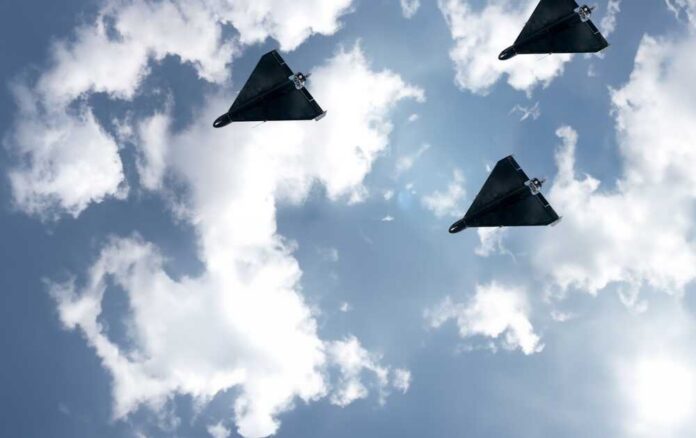
A new generation of U.S. “kamikaze” drones built from Iran’s own playbook just made its combat debut inside Iran, and Pentagon leaders are already calling them “indispensable.”
Story Snapshot
- LUCAS one-way attack drones, reverse-engineered from Iran’s Shahed-136, were used for the first time in combat during Operation Epic Fury.
- At roughly $35,000–$40,000 per drone, LUCAS gives America affordable, massed precision strike power instead of wasteful million-dollar missiles.
- Task Force Scorpion Strike and CENTCOM now see these drones as central to countering Iran’s missile and drone threat.
- The rapid 12–18 month path from concept to combat showcases a Trump-era emphasis on speed, lethality, and results over bureaucracy.
Reverse-Engineering Iran’s Drone Terror Into an American Advantage
For years, conservatives watched Iran and its proxies terrorize civilians and U.S. partners with Shahed-136 kamikaze drones while Washington’s political class preached climate conferences and “restraint.” Under Trump’s America First reset, the Pentagon finally flipped the script. After U.S. forces recovered intact Shahed drones from battlefields like Ukraine and the Middle East, American engineers decided not to wring their hands but to reverse-engineer the design into a U.S.-controlled weapon now known as LUCAS.
Arizona-based SpektreWorks first built a Shahed look-alike called the FLM-136 as a target drone so U.S. forces could train against the kind of low-flying, hard-to-track threats Iran had unleashed. Once operators saw how closely it mirrored the real thing, the question became obvious: why not arm it? Rather than pour money into yet another gold-plated program, defense leaders backed a modest contract—about $30 million—to convert this surrogate into a fully weaponized, low-cost strike system.
From Test Range Curiosity to “Indispensable” Combat Weapon
That decision produced the Low-cost Uncrewed/Unmanned Combat Attack System, or LUCAS, a one-way attack drone purpose-built for long-range precision strikes at a price everyday Americans would recognize from a pickup truck purchase, not a Pentagon boondoggle. Each airframe reportedly costs roughly $35,000–$40,000, a fraction of the tab for cruise or ballistic missiles that can run into the millions. That cost gap matters in a world where Iran and other adversaries churn out cheap drones by the hundreds while U.S. taxpayers foot the bill.
Late in 2025, Central Command quietly stood up Task Force Scorpion Strike under U.S. Special Operations Command Central, a small, focused unit designed to move fast and field one-way attack drones instead of getting bogged down in Beltway process charts. Within weeks, LUCAS went from test shots—like a December launch off the USS Santa Barbara in the Arabian Gulf—to full combat salvos in Operation Epic Fury, the joint U.S.–Israeli campaign targeting Iranian Revolutionary Guard command nodes, air defenses, drone launchers, and airfields deep inside Iran.
Affordable Mass: Hitting Hard Without Bleeding Taxpayers Dry
For a conservative audience tired of trillion-dollar wars and endless nation-building, the appeal is obvious: LUCAS delivers serious firepower without draining the treasury. Traditional long-range U.S. munitions such as Tomahawk or JASSM are highly capable but expensive and slow to replace. By contrast, LUCAS is designed for what Pentagon officials now call “affordable mass”—large salvos of attritable, expendable drones that can saturate enemy defenses and still be cheap enough to lose without bankrupting future readiness or Social Security checks.
In Epic Fury, these drones allowed U.S. and Israeli planners to hit multiple hardened, dispersed Iranian targets simultaneously while conserving the highest-end missile stocks for truly critical contingencies. For Iran’s Revolutionary Guard, that means every headquarters, radar site, and launch pad becomes harder to protect; they must spread out assets, spend more on air defenses, and accept that even remote facilities are no longer safe. For American families watching from home, it means deterrence on the cheap instead of another blank check overseas.
Trump-Era Speed Versus Bureaucratic Paralysis
One of the most revealing aspects of the LUCAS story is how fast it moved. Defense acquisition analysts describe a roughly 12–18 month sprint from the moment U.S. officials decided to copy the Shahed’s general form to the first acknowledged combat use over Iran. That stands in sharp contrast to the typical decade-long slog for Pentagon programs that line K Street pockets but arrive too late for real-world threats. Here, political cover for rapid warfighting acquisition made the difference.
Instead of endless studies, leaders empowered a small team, partnered directly with a nimble commercial firm, and fielded a working capability before Iran or Beijing could fully adjust. For conservatives who have long demanded that Washington act more like a results-driven business and less like a bloated bureaucracy, LUCAS offers a practical example: focus on the mission, trim the red tape, and deliver tools that actually protect Americans and our allies rather than advancing fashionable agendas in conference rooms.
What This Means for Future Wars and America First Security
Strategically, LUCAS signals that the United States will no longer cede the low-cost drone battlefield to authoritarian regimes. By adapting Iran’s own approach and improving it with U.S. navigation, networking, and autonomy, CENTCOM has shown that America can fight smarter as well as harder. Defense thinkers now expect similar one-way drones and autonomous swarms to spread to other theaters, including the Pacific, where numbers and cost per shot will heavily influence any contest with China.
For a Trump-supporting, security-minded public, the broader lesson is clear: when Washington stops apologizing for American power and starts prioritizing effectiveness over ideology, the military can field the right tools at the right price. LUCAS will not fix every threat, and details about its performance remain limited, but early results show a weapon that punishes Iran’s bad behavior, reinforces allies like Israel, and respects the American taxpayer far more than the bloated systems of the past.
Sources:
U.S. Military Has Used Long-Range Kamikaze Drones in Combat for the First Time – The War Zone
The LUCAS Drone Is a Needed Addition to America’s Arsenal Despite Its Modest Capabilities – Sandboxx
LUCAS Drones ‘Remain Ready’ After Operation Epic Fury Iran Strikes – DefenseScoop
US Confirms First Combat Use of LUCAS One-Way Attack Drone in Iran Strikes – Military Times
LUCAS: Rapid Warfighting Acquisition – Defense Acquisition