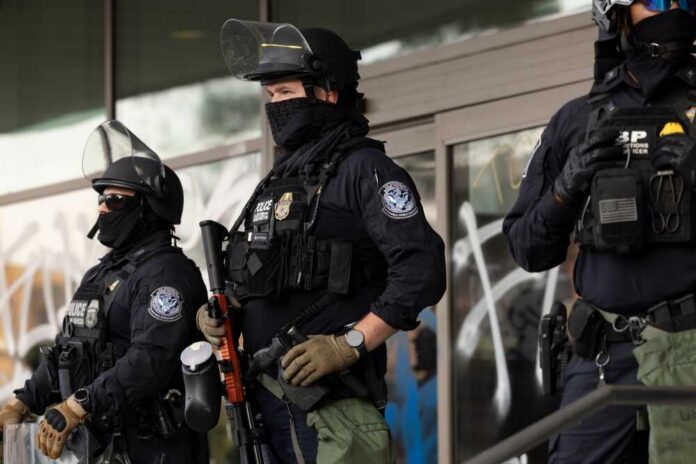
Minnesota’s Democratic-controlled Senate just passed legislation that would strip federal immigration agents of operational flexibility by mandating they reveal their identities and allow residents to sue them for constitutional violations—a move that raises serious questions about state overreach into federal enforcement and the real-world consequences for public safety.
At a Glance
- Minnesota Senate passed SF 4992, requiring federal agents to identify themselves during enforcement operations and prohibiting face coverings
- Bill establishes a private right of action allowing Minnesota residents to sue federal agents for alleged constitutional violations
- Legislation restricts federal agent access to state courthouses and requires hospitals to establish policies for law enforcement interactions
- Attorney General Keith Ellison led a 20-state coalition pushing Congress to pass similar federal legislation (H.R. 4176, the “No Secret Police Act”)
- Move reflects broader tension between state and federal authority over immigration enforcement, with potential legal challenges ahead
State Legislature Constrains Federal Immigration Enforcement
The Minnesota Senate passed comprehensive immigration enforcement legislation in May 2026 that directly restricts how federal agents operate within state borders. Bill SF 4992 mandates that federal agents identify themselves, state their law enforcement purpose, and provide warrant copies to court personnel. The legislation prohibits agents from concealing their identities during enforcement operations, fundamentally altering federal enforcement tactics that have been standard practice for years. This represents a significant assertion of state authority over federal immigration enforcement activities.
Private Right of Action Creates Litigation Pathway
A central provision of SF 4992 establishes a private right of action allowing Minnesota residents to sue federal agents for constitutional violations. This mechanism creates a new legal avenue for challenging federal enforcement practices without requiring government intervention. The bill also restricts federal agent access to state courthouses and mandates that hospitals establish policies governing law enforcement interactions. These provisions fundamentally reshape the legal landscape surrounding federal enforcement operations in Minnesota, potentially exposing federal agents to significant litigation exposure and creating uncertainty about operational procedures.
Multi-State Coalition Pushes Federal Legislation
Minnesota Attorney General Keith Ellison spearheaded a coalition of 20 state attorneys general in July 2025 urging Congress to pass the “No Secret Police Act” (H.R. 4176). Ellison published an essay titled “When the Law Won’t Show Its Face,” arguing that federal agents must be identifiable to ensure accountability and public safety. The coalition framed identification requirements as fundamental to transparency and community trust. However, the federal legislation’s current status remains unclear, leaving Minnesota’s state-level action as the primary mechanism for implementing these restrictions within the state’s borders.
Federal-State Conflict and Constitutional Questions Loom
The legislation raises fundamental questions about state authority versus federal preemption in immigration enforcement. Federal agencies like ICE argue that identification requirements and disclosure mandates compromise operational security and enforcement effectiveness. Constitutional scholars debate whether states possess authority to regulate federal agent conduct within their borders, particularly regarding private rights of action against federal officers. Legal challenges are anticipated, potentially reaching federal courts to determine whether Minnesota’s restrictions exceed state authority or violate principles of federal supremacy in immigration enforcement matters.
Implementation Challenges and Operational Impacts
SF 4992 creates substantial administrative burdens for federal agencies operating in Minnesota. Agents must modify identification and disclosure practices, provide warrant copies to court personnel, and navigate new courthouse access restrictions. Hospitals must establish new policies for law enforcement interactions. These requirements will likely cause operational delays during enforcement actions and increase administrative costs. The bill’s immunity provisions remain unclear, creating uncertainty about which government actors face liability and under what circumstances, potentially complicating federal-state law enforcement coordination.
Broader Implications for Federal Authority and State Sovereignty
Minnesota’s action signals a growing willingness among progressive states to constrain federal enforcement practices through state legislation. The precedent could encourage other Democratic-controlled states to adopt similar restrictions, fragmenting immigration enforcement across state lines. However, federal courts may ultimately determine that states lack authority to regulate federal agents or create private rights of action against federal officers. The outcome will significantly impact federal-state relations and establish whether states can effectively limit federal enforcement operations within their borders through legislative action and litigation mechanisms.
Sources:
Minnesota Attorney General’s Office: ICE Coalition Statement
Minnesota Legislature Revisor: SF 4992 Bill Text