
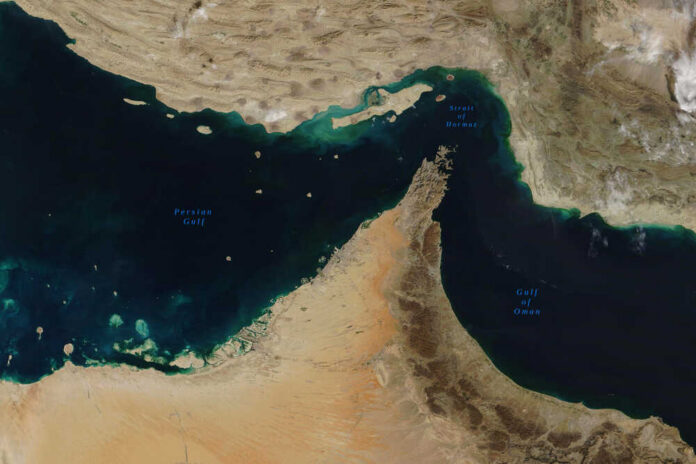
With the Strait of Hormuz effectively choked off, everyday Americans are once again staring down a familiar threat: skyrocketing energy prices driven by chaos overseas and years of fragile global supply chains.
Quick Take
- Shipping through the Strait of Hormuz has slowed to a near standstill, putting a major share of global oil and LNG flows at risk.
- Qatar has halted most LNG exports, while Iraq and Kuwait have shut oil production as storage fills and exports stall.
- Brent crude jumped above $92 on March 6, with U.S. oil benchmarks above $90 and gasoline up roughly 60 cents per gallon in reported moves.
- Analysts disagree on duration: some see limited “panic” and a future pullback, while others warn parts of supply may be offline for longer.
Hormuz Disruption Is the Real Shock, Not Just Headlines From the Battlefield
Early March 2026 brought a market jolt tied less to direct strikes on oilfields and more to a physical chokepoint problem: the Strait of Hormuz. Reports describe traffic close to a standstill, with commercial ships anchoring off the UAE as risk surged. Because the strait is a conduit for a large share of global seaborne oil and LNG, even partial disruption quickly tightens prompt supply and forces exporters to make hard operational decisions.
Gulf producers are responding in ways that matter for price and duration. Qatar has reportedly ceased most LNG exports, and Iraq and Kuwait have shut oil production, not necessarily because wells were destroyed, but because exports can’t reliably move and onshore storage fills. That dynamic is crucial: when the bottleneck is shipping and logistics, supply can be “available” in the ground yet unavailable to the world—exactly the kind of scenario that pushes spot prices higher.
Oil Has Spiked, But the $100 Narrative Needs Careful Framing
As of March 6 reporting, Brent crude moved above $92, up sharply on the week and year to date, while U.S. benchmarks traded above $90. Gasoline price impacts were also being felt, with reports citing roughly a 60-cent per gallon rise tied to the surge. Oil “surging above $100,” but the cited mainstream sources in this packet more consistently confirm the $90–$92 range at that moment, suggesting $100 may be imminent, intraday, or referenced elsewhere.
That distinction matters for readers trying to separate confirmed facts from fast-moving market chatter. One energy-market takeaway is that futures curves can signal less fear than headlines imply: analysts highlighted that forward contracts for 2027 were still around the $70 level in some snapshots. In plain English, traders may believe the immediate disruption is severe, but they are not uniformly pricing a permanent crisis—at least not yet—despite the ugly near-term squeeze.
Trump’s Pressure Campaign Meets a Global Supply System Built on Assumptions
President Trump’s posture toward Iran has been direct, including a demand for “unconditional surrender,” alongside measures intended to reduce market shock, such as naval escorts and insurance arrangements for shipping. Reports also indicate the administration loosened certain Russia-India oil sanctions constraints as a way to expand alternative supply flows. Those moves underscore a core reality: when a single route carries such an outsized share of energy trade, U.S. policy becomes partly about keeping commerce moving.
For conservative Americans still angry about inflation and cost-of-living damage from the last decade’s fiscal and energy-policy decisions, this moment is a reminder that energy prices are not just “corporate greed” or political talking points. They are the result of supply, security, and chokepoints. The more the U.S. relies on brittle international systems, the easier it is for hostile actors to impose real costs on American families—especially through fuel and transport.
How Long Could the Pain Last—and Who Gets Hit First?
Analysts outline scenarios ranging from short-lived spikes to longer-lasting premiums if supply is “locked away” by logistics, damage, or prolonged risk. Estimates tied to closure length suggest price impacts can vary widely, with some models pointing to modest increases for brief disruptions and steeper jumps if the strait is constrained for weeks. Europe and Asia appear especially exposed on natural gas, given LNG dependence and limited reserves in some regions.
Oil surges above the dreaded $100 level as Iran-war market disruption deepens https://t.co/MygqGvhDYl
— Jazz Drummer (@jazzdrummer420) March 9, 2026
Reports also emphasize second-order consequences that don’t show up immediately at the pump: disrupted LNG can raise European benchmark gas prices sharply, and prolonged high energy costs can squeeze emerging economies hardest. It suggests the global GDP hit could remain limited even in a longer conflict, but “limited” at the macro level can still translate into brutal household pressure through higher transportation, food distribution, and heating costs—especially if elevated prices persist beyond the initial shock.
Sources:
https://fortune.com/2026/03/07/iran-wear-energy-prices-iraq-kuwait-shut-oil-production/
https://www.csis.org/analysis/what-does-iran-war-mean-global-energy-markets
https://www.chathamhouse.org/2026/03/how-will-iran-war-affect-global-economy
https://www.goldmansachs.com/insights/articles/how-will-the-iran-conflict-impact-oil-prices