
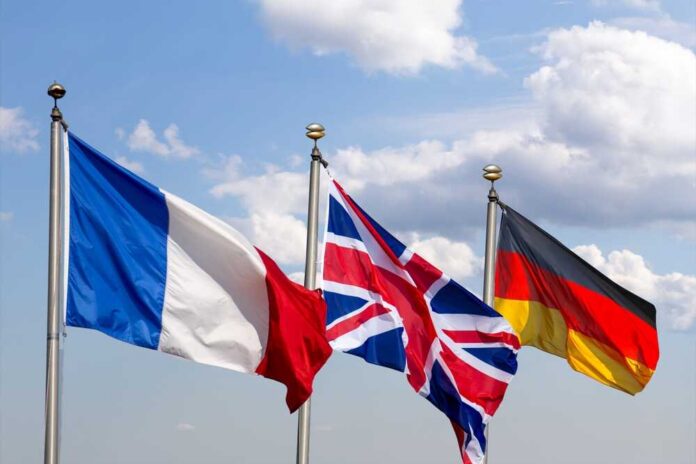
Europe’s top powers are now openly signaling they may join military action against Iran—raising the stakes for U.S. troops, Middle East stability, and the diplomatic leverage President Trump says he’s willing to use.
Story Snapshot
- Britain, France, and Germany issued a joint statement saying they are prepared for “necessary and proportionate defensive action” aimed at Iran’s missile and drone launch capabilities.
- The E3 leaders stressed they did not take part in the initial U.S.-Israeli strikes, but say Iran’s retaliatory attacks across the region could trigger their defensive involvement.
- Iran launched large-scale missile and drone attacks on Israel, U.S. installations, and Gulf Arab states after the February 28 strikes that killed Iran’s Supreme Leader Ali Khamenei.
- President Trump signaled openness to talks with Iran’s new leadership even as U.S. strikes continued and American casualties were reported.
E3 draws a line: defensive action “at the source”
Britain, France, and Germany moved beyond routine condemnation on March 1 by declaring they could enable “necessary and proportionate defensive action” to destroy Iran’s ability to fire missiles and drones “at their source.” Their joint language matters because it frames any future European role as defensive and targeted, not a broad new offensive campaign. The statement also emphasized coordination with the United States and regional allies as Iran’s attacks spread across multiple countries.
The E3 also tried to preserve diplomatic credibility by drawing a bright line between what happened first and what might come next. They said they did not participate in the initial U.S.-Israeli strikes that triggered Iran’s response. That distinction positions London, Paris, and Berlin as governments claiming they are reacting to Iranian escalation, not initiating conflict—an important point as European leaders sell any military posture to their own skeptical publics.
What triggered the escalation: leadership decapitation and retaliation
The timeline described in the reporting is stark. On February 28, U.S. and Israeli strikes killed Supreme Leader Ayatollah Ali Khamenei and other senior Iranian leaders, rapidly turning a long-running standoff into a leadership crisis inside the Islamic Republic. On March 1, Iran retaliated with large-scale missile and drone attacks targeting Israel, U.S. military installations, and Gulf Arab states, widening the battlefield and forcing allied militaries into immediate defense planning.
Early casualty figures underscore why outside governments are bracing for further escalation, even as some claims remain difficult to independently verify. Iranian authorities reported more than 200 people killed since strikes began, and at least nine people were reported killed in Beit Shemesh, Israel. A German military camp in eastern Jordan was reportedly impacted, though no casualties were reported there. The United States also suffered losses, with three U.S. service members reported killed.
Trump’s posture: military pressure paired with a negotiating window
U.S. operations described in the coverage included B-2 stealth bombers striking ballistic-missile-related facilities with 2,000-pound bombs. President Trump also claimed nine Iranian warships were destroyed and the Iranian navy headquarters was largely destroyed, though the public reporting cited does not describe independent confirmation of those specific battlefield claims. Even so, the overall picture is heavy U.S. pressure designed to reduce Iran’s capacity to sustain missile and drone attacks across the region.
At the same time, President Trump indicated he is willing to talk with Iran’s new leadership, saying they want to talk and that he agreed. That combination—military action to blunt attacks, plus a stated readiness to negotiate—creates a potential off-ramp if Tehran’s next leadership team is prepared to step back. For Americans exhausted by years of foreign-policy drift, the practical question is whether allies and adversaries treat negotiation as a path to de-escalation or merely a pause to reload.
Iran’s fast-moving power transition adds uncertainty for allies and civilians
Iran’s internal shift is happening under fire. Iranian President Masoud Pezeshkian said a new leadership council had begun operating and that a new supreme leader would be selected within one or two days. Iran’s foreign minister said the country was prepared to defend itself “by any means necessary,” language that suggests Tehran intends to keep responding as long as it believes its regime survival is threatened. That mix—rapid succession plus maximal rhetoric—makes future intent harder to read.
The reporting also described Tehran’s streets as largely deserted as civilians sheltered during airstrikes, alongside paramilitary checkpoints across the city. That detail matters because it highlights the human cost and the internal security posture that often accompanies regime stress. For Western governments, instability inside Iran can mean two competing dangers at once: opportunistic escalation abroad and harsher domestic repression at home, both of which can complicate diplomacy and planning.
What “necessary and proportionate” could mean—and what remains unknown
The E3 wording is deliberate and conditional, leaving open what they might actually do. The phrase “necessary and proportionate defensive action” implies a focus on missile and drone launch capabilities, potentially including support roles, intelligence, logistics, or direct strikes aimed at launch sites. The statement’s conditional tone also signals a political balancing act: European leaders want to deter further Iranian attacks while keeping space for “resumption of negotiations” rather than sliding into an open-ended war.
Key facts still limit firm conclusions. Independent verification of casualty totals and some battlefield damage claims remains limited in the public reporting. The scope of any European military action is also undefined beyond the stated intent to defend interests and allies and to reduce Iran’s missile-and-drone threat. What is clear is that Iran’s regional strike capability—and the willingness of major U.S. allies to help stop it—has become the central issue shaping the next phase.
Sources:
France, Germany, UK ready to take defensive action against Iran
Joint statement by the leaders of France, Germany and the United Kingdom on Iran (Feb. 28, 2026)
Britain, France, Germany ready to work with US to stop Iran’s retaliatory attacks
UK, France, Germany vow defensive action against Iran’s missile, drone capabilities
Joint E3 leaders statement on Iran: 28 February 2026