

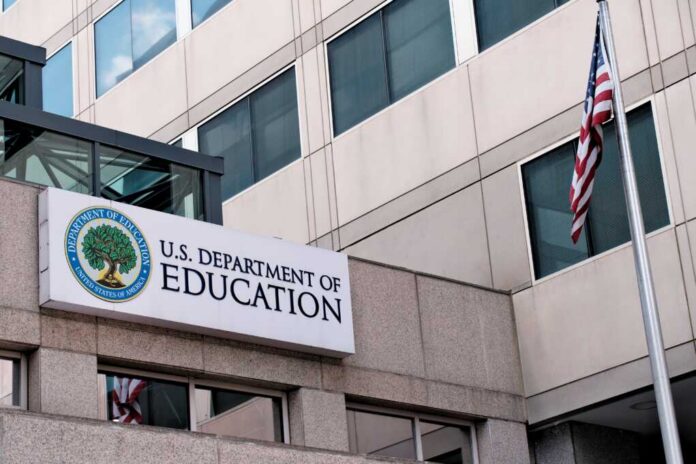
President Trump’s latest “hard reset” is shifting control of $1.7 trillion in student loans away from the Education Department—raising immediate questions about accountability, legality, and whether the federal bureaucracy is finally being forced to deliver basic results.
Quick Take
- The Trump administration launched a three-phase agreement on March 19, 2026, moving federal student-loan management from the Department of Education to the Treasury Department.
- Phase 1 starts with defaulted loans: 9.2 million borrowers and about $180 billion in debt shifting to Treasury’s collections authority.
- Later phases could expand Treasury’s role to non-defaulted loans and even FAFSA administration, further shrinking the Education Department.
- Officials say borrowers won’t need to take action and loan servicers will remain the same, but timelines for later phases are not set.
Treasury takes over defaulted loans first under a three-phase plan
Education Secretary Linda McMahon and the Trump administration announced an interagency agreement on March 19 that begins transferring management of the federal student-loan portfolio from the Department of Education to the Treasury Department. Phase 1 immediately focuses on defaulted loans, with Treasury resuming control of collections for roughly 9.2 million borrowers tied to about $180 billion. Administration officials said borrowers should see a “seamless” transition and will not need to take steps right now.
The agreement outlines Phase 2 as a Treasury assessment and potential assumption of operational responsibility for non-defaulted loans “to the extent practicable,” but the administration has not provided a firm timetable. Phase 3 would place Treasury in charge of FAFSA administration, building on an existing Treasury role that already supports data retrieval for aid applications. Together, the steps represent a major functional shift for an agency that has overseen student loans for decades.
The numbers driving the overhaul: $1.7 trillion, 40+ million borrowers, and rising distress
The transfer comes as federal student lending has grown into a massive $1.7 trillion portfolio serving more than 40 million borrowers. Reports cited a high default rate—about one-quarter of the portfolio—alongside signs of continued payment strain after pandemic-era disruptions. As of early March 2026, 9.2 million borrowers were in default, while another 2.4 million were delinquent and roughly 12 million were behind on payments as protections ended.
Those figures explain why collections policy matters to families and taxpayers alike. Treasury historically held default-collection authority, but that authority had been deferred to the Education Department. Under the new arrangement, Treasury’s involvement could accelerate standardized federal collections tools while keeping the same contracted servicers in place, at least initially. However, some potential consequences commonly associated with default collections—such as credit impacts or garnishment—remain politically sensitive, and reporting noted earlier delays around involuntary collections.
Government restructuring vs. congressional authority: what’s clear and what isn’t
The administration has portrayed the shift as an efficiency move and part of a broader effort to break up what it views as a bloated bureaucracy. At the same time, reporting underscored a core legal and constitutional tension: only Congress can formally close the Department of Education, yet the executive branch is using interagency agreements to move major functions elsewhere. Officials described the arrangement as a “partnership” and said the department would be wound down only “to the extent allowable by law.”
That distinction matters because federal law still assigns student-aid responsibilities to Education. Critics, including a union representing Education Department employees, argued the administration is unlawfully dismantling the agency without proper authority. Supporters counter that moving operations to Treasury is a management decision aimed at improving performance on a portfolio that has expanded dramatically, while leaving statutory responsibilities and policymaking boundaries to be worked out within existing legal limits.
A broader “shrink the agency” pattern is already underway across Education programs
This student-loan move is not a one-off. Reporting described it as the 10th interagency agreement tied to the administration’s plan to redistribute Education Department programs to other parts of the federal government. Earlier announcements included proposed transfers affecting K-12 programs, special education responsibilities, and civil-rights functions, though some of those moves have not yet been fully implemented. Congress has also signaled concern about these transfers even as fiscal-year funding debates continued.
For borrowers, the administration’s practical promise is continuity: no immediate action required and no immediate change in servicers. The uncertainty is strategic and structural: Phase 2 and Phase 3 lack specific timelines, and even supporters acknowledge implementation details will determine whether Treasury can outperform the current system. A past Treasury pilot on defaulted loans was reported to have underperformed private agencies, a caution that underscores why measurable results—not bureaucracy slogans—will ultimately decide whether this “hard reset” protects taxpayers and restores basic competence.
Sources:
Federal student loans will move to Treasury, further shrinking Education Department
Treasury Department begins taking over student loans as the Education Department gets dismantled
The Education Department will send more of its programs to other agencies
Trump administration moving federal student loan management to Treasury Department