

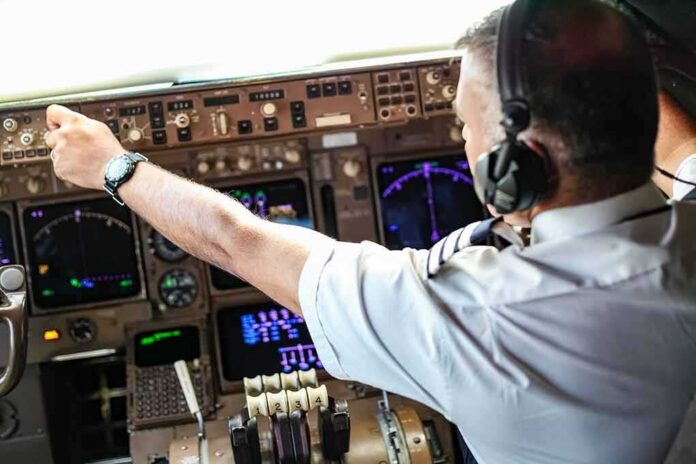
Investigators recovered the Learjet’s cockpit voice recorder after a Florida crash killed nine people, giving safety teams a crucial window into the final minutes of flight.
Story Snapshot
- The National Transportation Safety Board recovered the cockpit voice recorder and moved it to its lab for analysis.
- The Learjet 60 crashed near Greenacres, Florida, on November 1, killing all nine on board.
- The device was found at the initial impact site after excavation, tightening the search timeline.
- Federal law allows only a written transcript of cockpit audio to be released, not the audio itself.
Federal Investigators Secure Key Recorder From Crash Site
The National Transportation Safety Board said investigators recovered the cockpit voice recorder from the Learjet 60 that crashed near Greenacres, Florida, on November 1. The device was found at the initial impact site and transported to the National Transportation Safety Board Vehicle Recorders Laboratory in Washington, District of Columbia, for processing and review. The crash killed all nine people on board, prompting a full federal investigation into weather, maintenance, and cockpit actions in the final phase of flight.
Agency officials treat a recovered cockpit voice recorder as evidence, not as a final answer. The National Transportation Safety Board first preserves and processes the unit, then convenes a dedicated committee to prepare a transcript that investigators can use alongside radar, air traffic audio, and wreckage studies. That method keeps the focus on facts and sequence, rather than guesswork, so the safety board can pinpoint causes and recommend fixes that prevent repeat tragedies.
What The Cockpit Voice Recorder Can—and Cannot—Reveal
The cockpit voice recorder captures crew speech and cockpit sounds, not every aircraft system parameter. For many aircraft, the recorder keeps a rolling audio window, often the last two hours, by recording over older material. The transcript can reveal workload, warnings, checklist use, and coordination with air traffic control. It may also capture wind noise or alarms that help confirm weather or mechanical stress. But it will not replace a flight data recorder if one is absent or damaged.
Federal law protects cockpit voice recordings to support safety while shielding raw audio from public release. The United States Code bars the National Transportation Safety Board from releasing cockpit audio; only a written transcript may be shared, and only as allowed by statute. The National Transportation Safety Board’s media policy reinforces this rule and explains that any public transcript is produced after careful review through its established process. This legal guardrail respects crew privacy while still informing the public on safety lessons.
Investigative Priorities: Weather, Speed, and Structural Clues
Reporters and local outlets said severe weather pushed the crew and aircraft hard before the crash, and investigators noted reports about a possible “overspeed” condition under review. Evidence reported by aviation outlets suggests parts may have separated before impact, which will steer lab analysis of fractures and loads. The cockpit voice recorder can help anchor a minute-by-minute timeline, but final answers will rely on combined data, including wreckage, radar, maintenance records, and air traffic control tapes.
NTSB Recovers Cockpit Voice Recorder Following Fatal Florida Learjet Crash https://t.co/cfvW3WTQxP
— Policy Wire (@policy_wire) November 10, 2026
The National Transportation Safety Board’s structured approach serves a straight goal: find the cause and fix what failed. After lab work, specialists across operations, systems, meteorology, human factors, and structures compare notes and build a single factual record. That method avoids political spin and keeps accountability on real-world steps, such as equipment checks, training needs, or air traffic procedures. The process is slow by design, but it saves lives when its findings become action.
Why This Matters To Travelers And Taxpayers
Families deserve clear answers. Travelers need safe skies built on lessons learned, not press conferences. The cockpit voice recorder’s recovery is a concrete step that supports both. The process also respects limits on what the government should share and when, following law rather than hype. That balance—transparent results without a media circus—upholds common-sense government: do the work, protect privacy, release facts, and drive fixes that stop repeat mistakes.
What Comes Next In The Safety Board Timeline
Laboratory teams will extract audio, check quality, and align the timeline with air traffic control recordings and radar tracks. A cockpit voice recorder group will develop a transcript for the investigative docket when ready, consistent with federal statute and National Transportation Safety Board rules. The board will publish factual updates as milestones are met. A probable cause statement and safety recommendations will follow once all groups complete their work. Until then, officials will avoid speculation and let the evidence lead.
Sources:
washingtontimes.com, ntsb.gov, news.com.au, aerotime.aero, ecfr.gov