Iran’s Islamic Revolutionary Guard Corps has transformed the Strait of Hormuz into a militarized toll booth, dividing global shipping into three categories and forcing vessels to pay fees or face permanent blockade—a dangerous precedent that exposes American allies to terrorist-designated enforcers while Trump’s administration watches a critical oil chokepoint slip from international control.
Story Snapshot
- IRGC enforces vetting system requiring vessels to submit documentation, obtain clearance codes, and pay fees up to $2 million to transit through single controlled corridor
- Iran categorizes ships into “friendly,” “Iranian-affiliated,” and “hostile” groups, with US and Israel allies completely blocked from passage
- Nearly 2,000 vessels were stranded after February 28 blockade; 67-90% of current transits are Iranian-linked, threatening 20% of global oil supply
- Shipping operators face sanctions exposure by paying terrorist-designated IRGC, while Tehran considers formal toll legislation violating international transit rights
IRGC Seizes Control of Critical Chokepoint
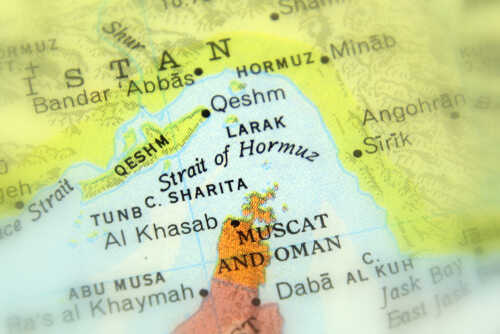
The Islamic Revolutionary Guard Corps converted its February 28 blockade of the Strait of Hormuz into a structured control system by mid-March 2026, funneling all vessel traffic through a single corridor near Larak Island. The IRGC Navy’s Hormozgan Provincial Command now requires ships to submit IMO numbers, ownership details, cargo manifests, and crew lists for vetting before issuing clearance codes. No transits have occurred via the normal two-lane channel since March 15, according to AIS tracking data. At least two vessels have paid fees—one reportedly $2 million, another in Chinese yuan—while others navigate passage through diplomatic coordination with Iranian Foreign Minister Abbas Araghchi.
Three-Tiered System Divides Global Powers
Tehran explicitly categorizes vessels into three groups: Iranian-affiliated ships transit unhindered and comprise 67-90% of recent passages; “friendly” or “non-hostile” nations including China, India, Pakistan, Malaysia, South Korea, Egypt, and Greek-affiliated vessels gain passage through diplomatic channels, with Chinese ships accounting for 10% and Greek 15% of non-Iranian transits; vessels from the United States, Israel, and their allies face complete exclusion as “aggressors.” Iran’s communication to International Maritime Organization members promises “non-hostile” vessels may pass “in coordination,” but this selective framework prioritizes nations willing to engage Tehran diplomatically while punishing Western allies. Some Indian vessels have secured passage without fees through government intervention, revealing the political leverage Iran extracts from this chokehold.
Sanctions Risk and Constitutional Concerns
American shipping operators and allied nations confront a dangerous dilemma: pay fees to a U.S.-designated terrorist organization or abandon routes carrying 20% of global oil trade. Sanctions experts warn payments to the IRGC risk severe U.S., U.K., and E.U. penalties, despite Iran’s “non-hostile” classification claims. The Iranian parliament’s consideration of formal toll legislation threatens to institutionalize this extortion, directly violating the 1982 United Nations Convention on the Law of the Sea guaranteeing innocent transit passage rights. This system sets a catastrophic precedent for militarized control of international chokepoints, undermining freedom of navigation principles that protect American commerce and energy security. The Trump administration’s limited response to this Iranian power grab contradicts promises to keep America out of entangling conflicts while protecting vital interests.
Economic and Strategic Fallout
The IRGC’s vetting process creates immediate disruptions: shipping costs spike from insurance hikes and delays; stranded vessels number in the thousands; oil importers across China, India, and Europe face supply uncertainty. Long-term implications include sustainable revenue streams for Tehran’s regime and emboldened adversaries who may replicate toll systems at other strategic waterways. The Strait’s narrow geography—21 to 60 miles wide—enables easy IRGC dominance via fast boats and armed pilots, making military reversal costly. Iran’s transformation of retaliation for U.S.-Israel strikes into permanent infrastructure for global shipping control exposes the failure of endless Middle East interventions to secure American interests, instead creating new vulnerabilities that drive energy costs higher for working families already battered by inflation from years of fiscal mismanagement.
The IRGC’s “toll booth” reveals how foreign entanglements produce unintended consequences: a terrorist organization now collects fees from global commerce while dividing nations into approved and banned categories, all stemming from strikes that dragged America deeper into regional conflict. Conservative voters who supported Trump’s America First agenda expected energy independence and disengagement from regime change wars, not scenarios where allies must negotiate with terrorists to move oil. This crisis underscores the need for domestic energy production and withdrawal from Middle East quagmires that enrich adversaries, threaten constitutional commerce protections, and betray promises to prioritize American security over globalist interventions.
Sources:
Tehran’s toll booth system is now controlling Hormuz traffic
Iran Hormuz toll booth legally risky route for shippers
Strait of Hormuz toll booth system Iran control over waterway West Asia crisis
Iran’s toll booth chokehold Strait
Iran approves toll on the Strait of Hormuz but does it have the right to
Strait of Hormuz which countries ships are allowed to pass through Iran’s chokehold and which aren’t