

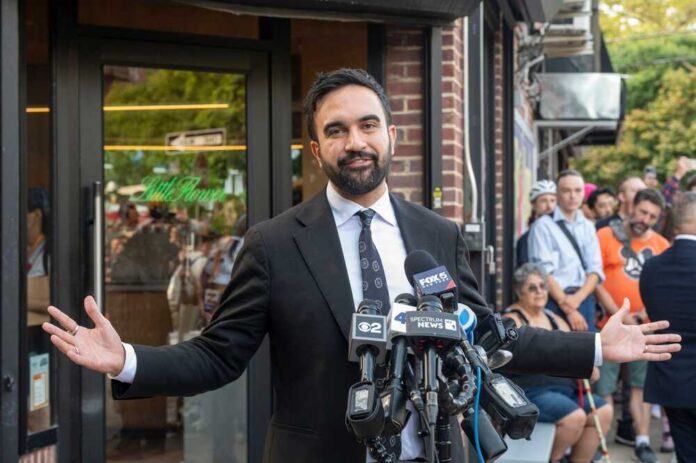
New York City’s City Hall became the latest battlefield in America’s culture war after Mayor Zohran Mamdani hosted a public Ramadan iftar inside the seat of city government—sparking fresh questions about church-state lines, public trust, and what “inclusion” means when politics picks the venue.
Quick Take
- Mayor Zohran Mamdani hosted a public Ramadan iftar dinner inside NYC City Hall on March 11, 2026, and praised the “transformation” of the space.
- Videos of the event spread rapidly online, with critics arguing City Hall should not be used to stage religious observances.
- Social media controversy intensified over a guest’s hand gesture that critics described as an “ISIS salute,” a claim not independently confirmed.
- The episode lands amid separate NYC disputes over speech and public order, including a City Council ethics case tied to online remarks and an earlier NYPD street-preaching arrest.
City Hall Iftar Ignites Church-State Debate in New York
New York City Mayor Zohran Mamdani hosted a Ramadan iftar dinner inside City Hall on March 11, 2026, drawing immediate backlash and renewed debate about the proper use of government property. The event was framed by supporters as a gesture of civic inclusion during Ramadan, the month when Muslims fast from dawn to sunset. Critics, however, argued that turning a core government space into a venue for a religious meal blurs long-contested boundaries in American public life.
Footage circulating online showed attendees seated closely together, including some sitting on the floor, and included remarks from Mamdani expressing gratitude to those present and commenting on the space’s “transformation.” The viral clips became the central fuel for criticism, not only because they took place in City Hall but because opponents viewed the symbolism as political. It does not establish whether any formal policy was changed, only that the mayor authorized and hosted the event.
Online Claims About an “ISIS Salute” Remain Unverified
One flashpoint came from video clips that critics said showed a guest making an “ISIS salute,” described as a one-finger gesture. In the material provided, the allegation is presented as a claim amplified through commentary and social media rather than a conclusion supported by independent verification. That distinction matters, because gestures can be interpreted differently depending on context and intent. As presented, the controversy demonstrates how quickly provocative imagery can escalate into sweeping accusations without clear corroboration.
The same coverage linked the uproar to New York’s post-9/11 sensitivities, emphasizing the emotional weight of any Islamist-related symbolism in a city that still carries the scars of the 2001 attacks. It also noted the event’s proximity to Ground Zero as part of the political argument against holding the gathering at City Hall. While proximity alone does not prove wrongdoing, it helps explain why critics saw the location choice as inflammatory and why the online reaction expanded beyond local governance into national cultural conflict.
Gracie Mansion Guest Adds Another Layer of Political Tension
The City Hall iftar followed a separate, private iftar hosted by Mamdani at Gracie Mansion on March 10, 2026, for Mahmoud Khalil and his family. It describes Khalil as a Syrian activist and Columbia student who faced immigration scrutiny, including allegations of green card fraud and the possibility of deportation under the Trump administration. Those details heightened partisan sensitivity, because critics interpreted the invitation as political signaling in an already volatile immigration environment.
On the facts available, the strongest conclusion is narrow: the mayor held two iftars in official-adjacent spaces on consecutive days, and the second occurred inside City Hall. Whether those actions violate any constitutional principle depends on equal-access practices and longstanding rules about government facilities. It provided does not include City Hall’s event policies, permit details, or any legal analysis from city attorneys, which limits what can be responsibly claimed about legality versus optics.
Free Speech Fights Collide With Government “Sensitivity” Enforcement
Separate from the iftar debate, New York City is also wrestling with First Amendment questions from multiple angles. The research references a City Council ethics case involving Queens Councilmember Vickie Paladino over social media posts characterized as anti-Muslim, with the Council pursuing discipline under internal conduct rules. An attorney quoted in that coverage summarized a key distinction: government generally cannot criminally punish speech, but it can enforce workplace and internal standards related to harassment and discrimination within its own operations.
Another referenced case involves Pastor Aden Rusfeldt, who was arrested by NYPD in 2021 while street preaching, with the dispute described as a “heckler’s veto” fight—where authorities allegedly curtail speech because a hostile crowd objects. Together, these episodes show why conservatives are wary: the same institutions that can quickly police “offensive” speech sometimes struggle to protect unpopular speech in public. The public’s confidence erodes when enforcement looks selective or politically convenient rather than even-handed.
Sources:
Shocking Video Out of NYC Almost Makes Me Rethink This Whole ‘First Amendment’ Thing
Street preacher showdown pits NYPD against First Amendment